
 English
 Español
 中文简体
中文简体
Content
- 1 Understanding the Automatic Water Dispensing System
- 2 Mop Head: Rotation Range, Size, and Material
- 3 Bucket Design: Capacity, Clean/Dirty Water Separation, and Build Quality
- 4 Handle Ergonomics and Adjustable Length
- 5 Floor Type Compatibility: Matching the Mop Set to Your Surfaces
- 6 Durability and Material Quality: What to Look for Long-Term
- 7 Storage, Portability, and Space Efficiency
- 8 Key Selection Checklist Before Purchasing
Choosing the right automatic water flat mop bucket set comes down to five core factors: the water dispensing mechanism and control precision, mop head rotation range and material, bucket capacity and separation design, handle ergonomics and length adjustability, and compatibility with your specific floor types. An automatic water flat mop bucket set eliminates the manual wringing and repeated bucket dunking of traditional mops, delivering a controlled amount of clean water with each pass and keeping dirty water separated from clean — producing a genuinely cleaner floor with significantly less effort. Getting the selection right means your floors dry faster, stay cleaner longer, and the set lasts through years of daily use.
Understanding the Automatic Water Dispensing System
The defining feature of an automatic water flat mop set is its built-in water dispensing mechanism — the component that sets it apart from conventional flat mops and determines much of its practical value. Not all dispensing systems are equal, and understanding how they differ helps identify which design suits your cleaning needs.
Spray-Trigger Dispensing
The most common mechanism in quality flat mop sets uses a spray trigger or press button on the handle to release a fine mist of water directly onto the floor ahead of the mop head. This approach gives the user precise control over when and how much water is applied — ideal for sensitive floor surfaces such as hardwood, laminate, and engineered wood where excess water causes swelling and warping. A well-designed spray head distributes water evenly across a 30–40 cm spray width, matching the mop head footprint and eliminating dry patches or over-wetted areas.
Gravity-Feed Dispensing via Bucket Wringer
Some bucket set designs integrate a wringer mechanism that applies controlled pressure to the mop head as it is inserted into a bucket-mounted wringer, simultaneously squeezing out dirty water and reloading the mop head with a calibrated amount of clean water from a separate clean-water compartment. This design works well for large-area cleaning where continuous water supply is more important than precise per-pass control.
What to Check Before Buying
- Confirm that the water tank capacity is sufficient for your cleaning area — typical tank sizes range from 300 ml to 600 ml. A 400 ml tank covers approximately 40–50 m² of floor area before requiring a refill when used with a fine spray.
- Check whether the water tank is removable and easy to fill and clean. Tanks that can only be filled through the handle top are less convenient than those that detach completely for direct filling at the sink.
- Look for spray mechanisms with a fine, even mist pattern rather than a stream or drip. Streams create puddles that take longer to dry; fine mists evaporate in 2–5 minutes on most floor types under normal conditions.
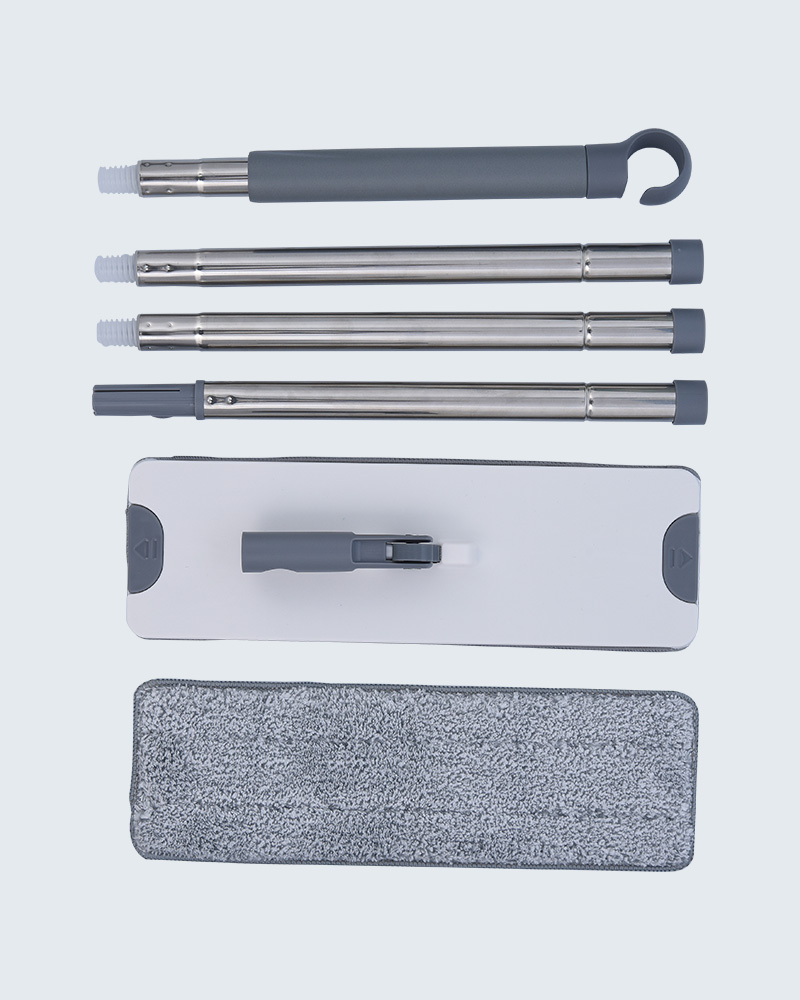
Mop Head: Rotation Range, Size, and Material
The mop head is the component that makes direct contact with the floor and determines cleaning reach, surface adaptability, and how effectively the set removes different types of soiling. All three characteristics — rotation, size, and material — matter for everyday performance.
360° Rotation for Maximum Manoeuvrability
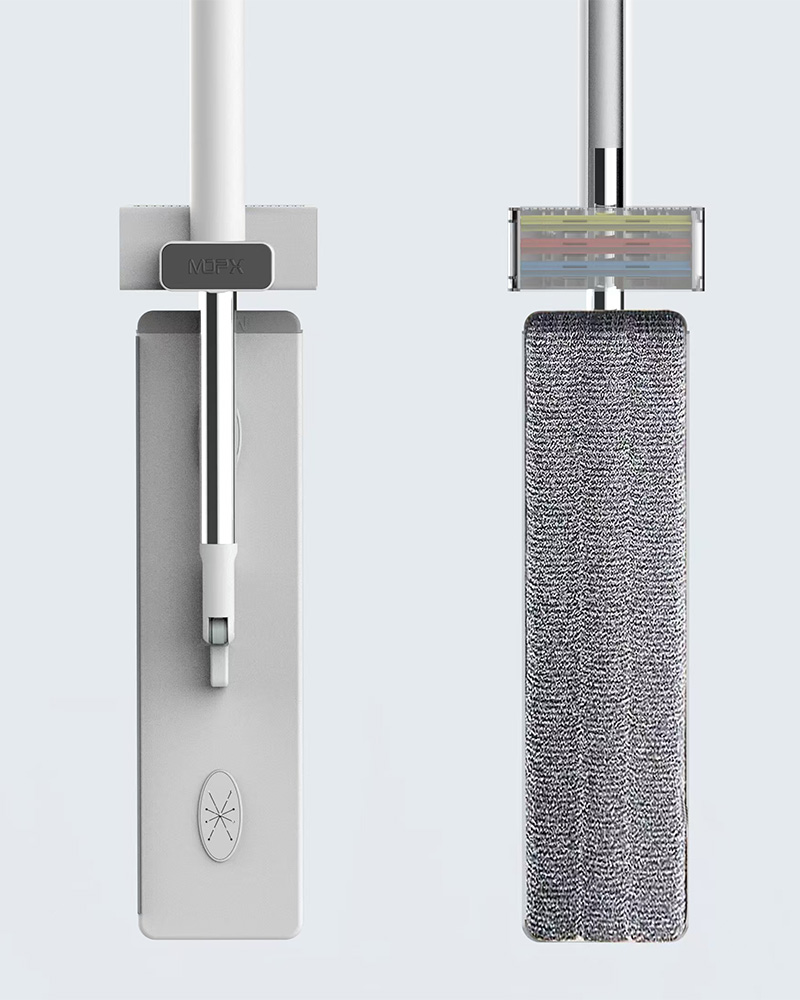
A mop head that rotates a full 360 degrees allows the user to clean around furniture legs, into corners, along skirting boards, and under low furniture without repositioning their body or changing grip. This is one of the most practically valuable features of a modern flat mop set and a key differentiator from fixed-head designs where every direction change requires lifting and repositioning the mop. When evaluating a mop set, confirm the rotation joint moves smoothly through the full range and that it locks at the most commonly used angles (typically 0° and 180°) to prevent unwanted swivelling during straight-run cleaning.
Mop Head Width and Floor Coverage
Mop head widths in flat mop sets typically range from 32 cm to 46 cm. Wider heads clean more floor per pass and are more efficient for open areas such as living rooms and hallways. Narrower heads offer better manoeuvrability in tight spaces such as between bathroom fixtures or around kitchen cabinetry. For most homes, a 40 cm width offers the best balance of coverage and manoeuvrability.
Mop Pad Material: Choosing Between Microfibre and Other Options
The mop pad material directly affects cleaning performance, absorbency, surface compatibility, and durability. The key options are:
- Microfibre pads: The most effective option for most floor types. High-quality microfibre has a fibre diameter of under 10 microns, which creates a vast surface area that physically traps and holds dirt, bacteria, and fine dust rather than simply redistributing them across the floor. Microfibre pads are safe on hardwood, laminate, tile, vinyl, and stone, and can be machine-washed up to 300–500 times before performance degrades noticeably.
- Cotton/blended pads: More absorbent than microfibre for wet cleaning of heavily soiled tile or concrete floors. Less effective for dry dusting. Cotton pads tend to leave more streaks on smooth floor surfaces and may absorb more water than needed for delicate flooring.
- Dual-sided pads: Some mop sets include pads with a scrubbing strip on one side and a microfibre cleaning face on the other, allowing the user to tackle stubborn marks without switching pads. Particularly useful in kitchens where dried food residue is common.
Bucket Design: Capacity, Clean/Dirty Water Separation, and Build Quality
The bucket in an automatic flat mop set is not simply a water container — in a well-designed set it functions as a water management system. The quality of the bucket design determines whether your cleaning solution stays clean throughout the job or rapidly becomes contaminated with the dirt you are trying to remove.
Single vs. Dual-Compartment Buckets
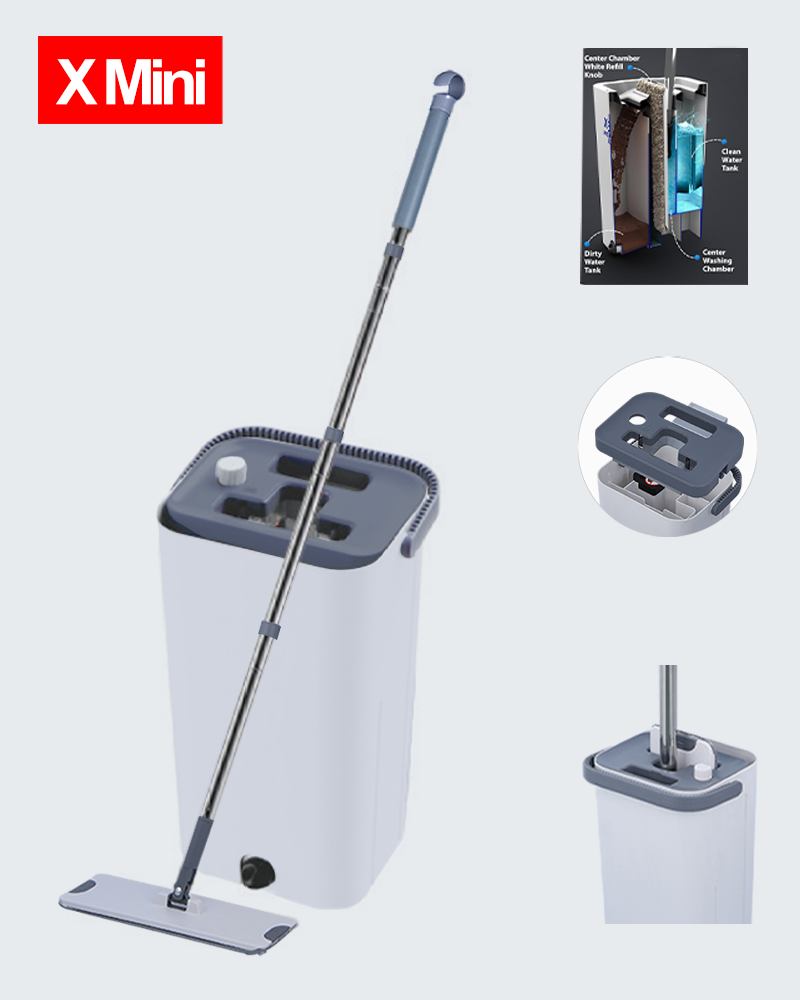
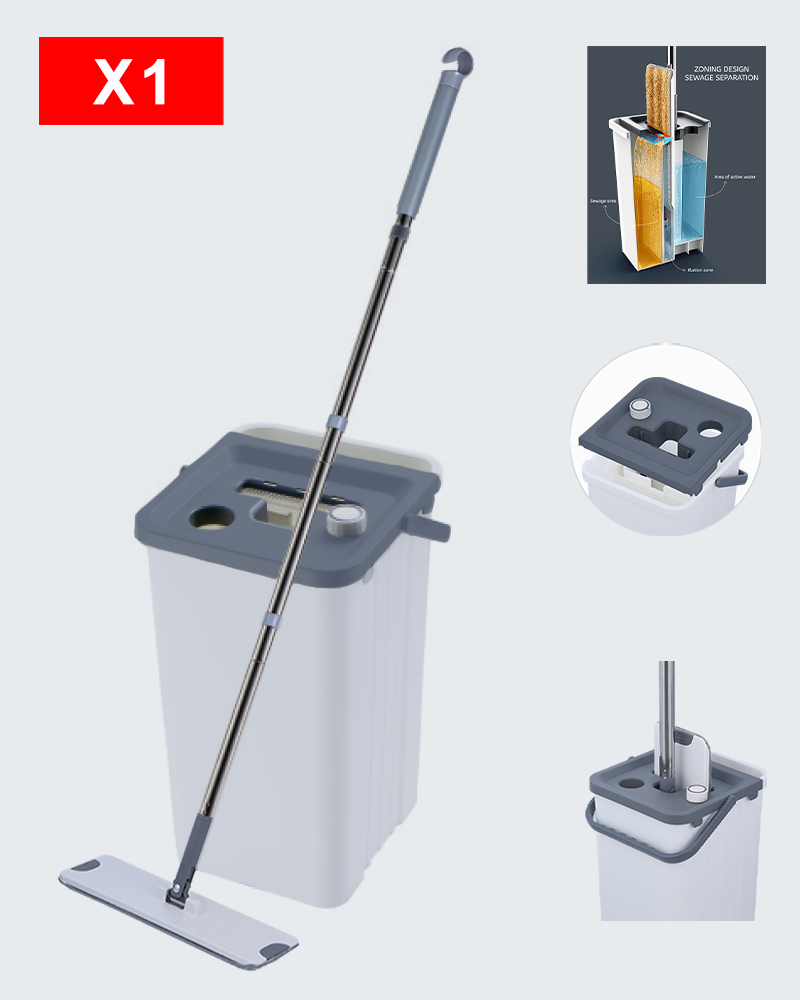
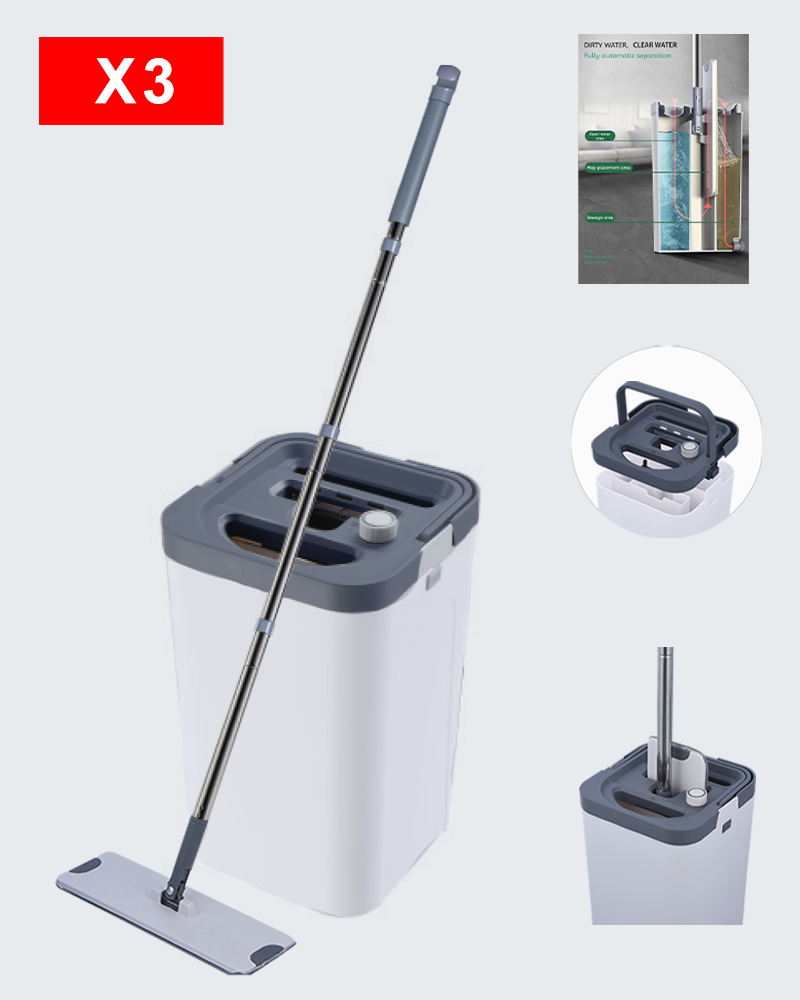
Basic flat mop bucket sets use a single-compartment bucket — the same water that was clean at the start progressively accumulates the dirt wrung from the mop. By the time a medium-sized room is half-cleaned, the water in the bucket is often dirtier than the floor. Dual-compartment buckets separate clean and dirty water physically — clean water is held in a dedicated section that feeds the mop, and wrung-out dirty water drains into a separate section that is never returned to the mop head. This design produces measurably better cleaning results and is strongly recommended for anyone who takes floor cleanliness seriously.
Bucket Capacity
Bucket capacity is an important practical consideration, especially for larger homes or open-plan spaces. Common capacities for flat mop buckets range from 8 litres to 15 litres. A 10-litre bucket is sufficient for cleaning areas of up to approximately 50–60 m² per fill under normal soiling conditions. For homes larger than 100 m², a 12–15 litre bucket reduces the number of water changes required per cleaning session.
Wringer Mechanism and Bucket Material
The bucket wringer must apply even, consistent pressure across the full width of the mop head to wring it effectively without leaving one side wetter than the other. Look for wringers with a wide press plate or roller system rather than a narrow central bar, which leaves the edges of the pad inadequately wrung. Bucket material should be heavy-duty polypropylene (PP) rather than thin PET — thick PP walls resist cracking under the pressure of the wringer mechanism and do not become brittle with age or cleaning chemical exposure.
Handle Ergonomics and Adjustable Length
The handle is the primary user interface of the mop set, and its ergonomics directly affect both the comfort of extended cleaning sessions and the effectiveness of the cleaning motion. Poor handle design leads to back strain, awkward reach, and reduced pressure control — all of which compromise the cleaning result.
- Adjustable length: A telescoping handle with a length range of approximately 90–130 cm accommodates users of different heights and allows the handle to be shortened for low-clearance areas such as under beds or tables. Confirm the adjustment mechanism locks securely at the chosen length without creeping shorter during use — a common failure point in lower-quality handles.
- Handle material: Aluminium handles offer a good balance of lightweight feel and rigidity. Stainless steel handles are stronger but heavier. Avoid plastic handles on heavier mop sets — they flex under pressure, reducing control, and may crack at the connection point over time.
- Grip design: A non-slip, ergonomically contoured grip reduces hand fatigue during prolonged cleaning sessions. Soft-touch rubber or TPR grips are preferable to bare metal or smooth hard plastic, particularly when hands are wet.
- Water tank trigger position: In spray-type systems, the trigger should fall naturally under the thumb or index finger without requiring a grip change or wrist rotation. An awkwardly positioned trigger leads to inconsistent water application and additional hand strain.
Floor Type Compatibility: Matching the Mop Set to Your Surfaces
Not all automatic flat mop sets are suitable for all floor types. Using an incompatible mop on a sensitive floor surface can cause permanent damage — particularly to hardwood, engineered wood, and laminate, which are easily harmed by excess moisture.
| Floor Type | Water Sensitivity | Recommended Pad | Dispensing Mode |
|---|---|---|---|
| Solid hardwood | High — excess water causes warping | Dry or barely damp microfibre | Spray mist only; minimal water |
| Engineered wood / laminate | Moderate-high | Microfibre (damp) | Spray mist; avoid standing water |
| Ceramic / porcelain tile | Low | Microfibre or cotton blend | Wet or damp — both suitable |
| Natural stone (marble, slate) | Moderate (cleaning agent sensitivity) | Microfibre (soft) | Damp mist; pH-neutral solution only |
| Vinyl / LVT | Low | Microfibre | Wet or damp — both suitable |
| Polished concrete | Low | Microfibre or cotton | Wet cleaning — quick to dry |
A quality automatic water flat mop bucket set should be suitable for both wet and dry cleaning modes — dry mode using a clean microfibre pad for daily dust and fine debris collection, and wet mode using the spray or dispensing system for deeper cleaning. Versatility across modes eliminates the need for separate dry-dusting and wet-cleaning tools.
Durability and Material Quality: What to Look for Long-Term
Daily use is a demanding test for any cleaning tool. A flat mop bucket set used twice weekly over five years undergoes more than 500 cleaning cycles, involving repeated water exposure, chemical exposure, mechanical stress on the wringer and joints, and physical impacts in storage. Material and construction quality determine whether the set performs reliably throughout this period or degrades within months.
- Mop head connector: The joint between the handle and the mop head plate is the most mechanically stressed point of the entire system. Check that it is made from reinforced nylon, aluminium alloy, or similar rigid material — not thin plastic — and that the rotation mechanism is supported by a ball bearing or bushing rather than bare plastic-on-plastic contact.
- Water tank and tubing: Internal water tanks and tubes that carry cleaning solution are in constant contact with water and detergents. Confirm they are made from food-safe PP or HDPE that resists staining, odour absorption, and degradation from common household cleaning agents.
- Spray nozzle serviceability: Spray nozzles can clog from limescale deposits in hard water areas. Choose a set where the nozzle is accessible and removable for cleaning or replacement, rather than permanently sealed into the handle.
- Pad attachment system: Microfibre pads should attach and detach quickly without tools — hook-and-loop (Velcro-type) attachment and pocket-style attachment are both effective. Avoid clip systems with small plastic clips that break or lose spring tension after repeated washing cycles.
Storage, Portability, and Space Efficiency
A flat mop bucket set that is cumbersome to store or difficult to move between rooms reduces the likelihood of being used regularly — directly undermining its value as a cleaning tool. Practical storage and portability features to look for include:
- Compact footprint: Quality flat mop buckets are designed with a rectangular profile that fits neatly against a wall or in a cupboard. Confirm the bucket's footprint dimensions fit your storage space before purchasing — bucket widths range from approximately 28 cm to 40 cm.
- Integrated bucket handle: A robust bucket carry handle allows the set to be moved between rooms without difficulty, even when partially filled. Confirm the handle is rated for the full bucket weight when loaded — a 12-litre full bucket weighs approximately 12 kg.
- Mop storage within the bucket: Some flat mop sets allow the mop handle to be rested in a clip or holder integrated into the bucket when moving between rooms, keeping the mop head off the floor and preventing dripping. This feature is particularly useful when moving a partially wet mop across different floor zones.
- Bucket portability wheels: For larger capacity buckets (12 litres+) that become heavy when fully loaded, integrated wheels or a recessed base that accommodates a small trolley make transportation between rooms significantly easier.
Key Selection Checklist Before Purchasing
Use this checklist to evaluate any automatic water flat mop bucket set before committing to a purchase:
- Water dispensing mechanism: Confirm it is spray-trigger, gravity-feed, or pump type, and that the system is appropriate for your most sensitive floor surface.
- Water tank capacity: Verify the tank size (typically 300–600 ml for spray systems) covers your cleaning area without excessive refilling interruptions.
- Mop head rotation: Confirm full 360° rotation and smooth, controlled movement through the range — test this in person or check verified user reviews for binding or stiffness reports.
- Pad material and washability: Verify microfibre specification and confirmed machine-wash durability of at least 300 cycles before pad replacement is needed.
- Bucket design: Dual-compartment clean/dirty water separation is strongly preferred for effective cleaning results. Check bucket material is heavy-duty PP.
- Handle adjustability: Confirm the telescoping range covers your height and that the lock mechanism is secure under pressure.
- Floor type compatibility: Confirm the set is rated for your specific floor surfaces — particularly if you have hardwood or laminate that requires moisture-controlled application.
- Wet and dry mode capability: Confirm the mop head supports dry cleaning with a clean pad for daily use in addition to wet cleaning — maximising the set's practical versatility.
- Replacement pad availability: Check that replacement microfibre pads for the specific mop head size are readily available and reasonably priced before committing to the set.
- Warranty: A minimum 12-month warranty covering defects in the dispensing mechanism and connector joint is a reasonable expectation for a quality automatic flat mop bucket set.