
 English
 Español
 中文简体
中文简体
Content
- 1 What Is a Flat Mop Bucket Set?
- 2 Key Advantages That Make Flat Mop Bucket Sets Worth Using
- 2.1 Hands-Free Wringing Keeps Cleaning Hygienic
- 2.2 Clean/Dirty Water Separation Produces Better Results
- 2.3 Flat Head Design Covers More Floor Area Per Stroke
- 2.4 Microfiber Pads Clean More Effectively at Lower Temperatures
- 2.5 Reusable and Machine-Washable Pads Reduce Ongoing Cost
- 2.6 Ergonomic Handle Design Reduces Physical Strain
- 3 Flat Mop Bucket Set vs. Traditional Mop and Bucket: A Direct Comparison
- 4 What Floor Types Are Flat Mop Bucket Sets Suitable For?
- 5 What to Look for in a Good Flat Mop Bucket Set
- 6 Who Benefits Most from a Flat Mop Bucket Set?
- 7 How to Use a Flat Mop Bucket Set for Best Results
- 8 Common Questions About Flat Mop Bucket Sets Answered
- 9 Flat Mop Bucket Set Maintenance and Longevity Tips
- 10 About Ningbo Yaxiang Cleaning Products Co., Ltd.
Yes — a flat mop bucket set is genuinely good, and for most households it represents a significant upgrade over traditional string mops and standalone buckets. The combination of a flat mop head, a hands-free wringing mechanism, and a purpose-designed bucket delivers faster cleaning, drier floors, and less physical effort than conventional mopping systems. For busy families, people who clean frequently, or anyone who wants to reduce the time and mess involved in floor care, a flat mop bucket set is one of the most practical investments in home cleaning. The key is understanding what makes a quality set and whether the features match your specific needs.
What Is a Flat Mop Bucket Set?
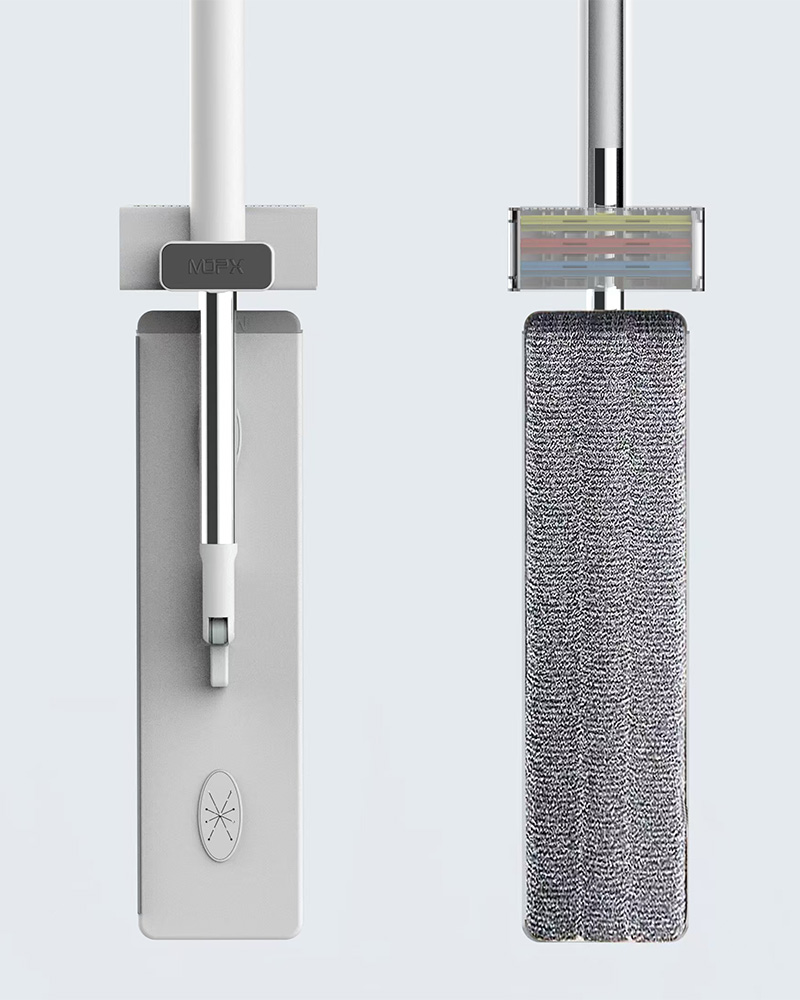
A flat mop bucket set is an all-in-one floor cleaning system that typically includes a flat mop with a microfiber or absorbent pad head, an extendable handle, and a specially designed bucket with a built-in wringer or press mechanism. Unlike traditional round mop systems, the flat design allows the mop head to lie flush against the floor surface, covering more area per stroke and reaching under furniture, into corners, and along baseboards with far greater efficiency.
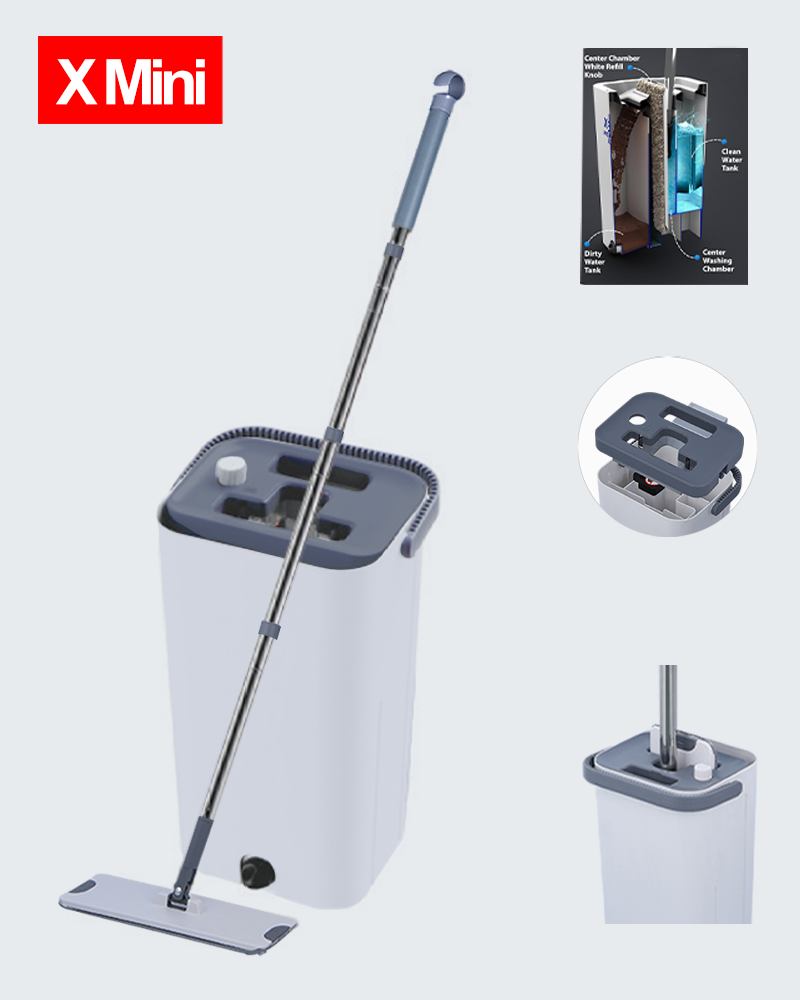
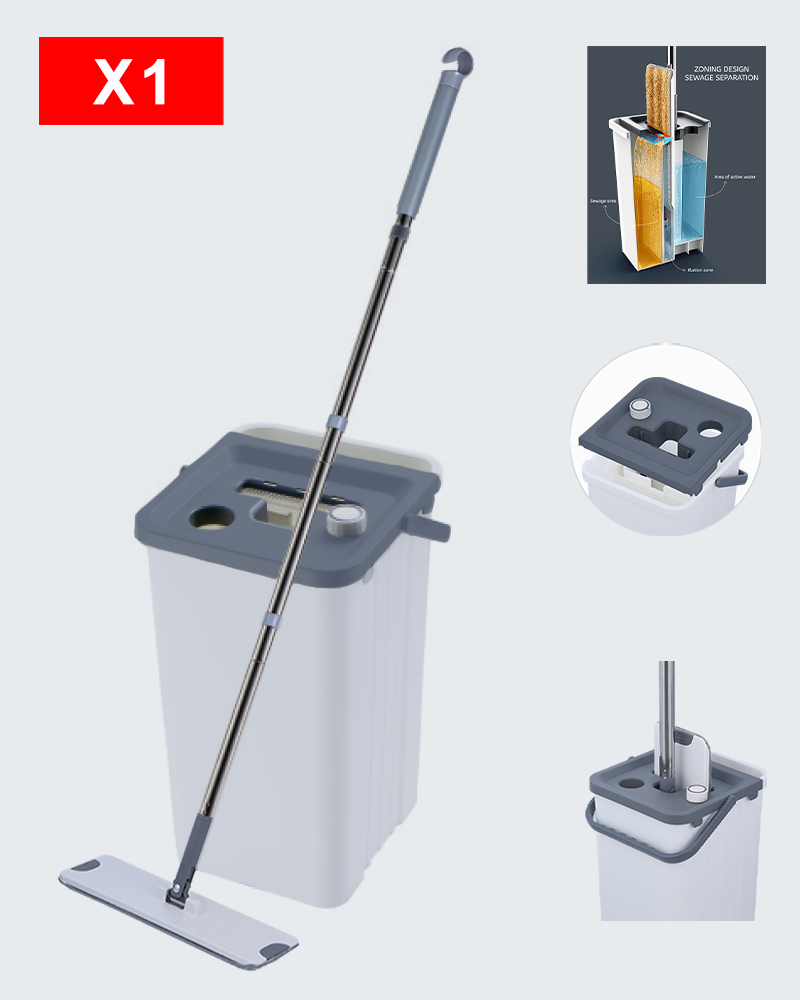
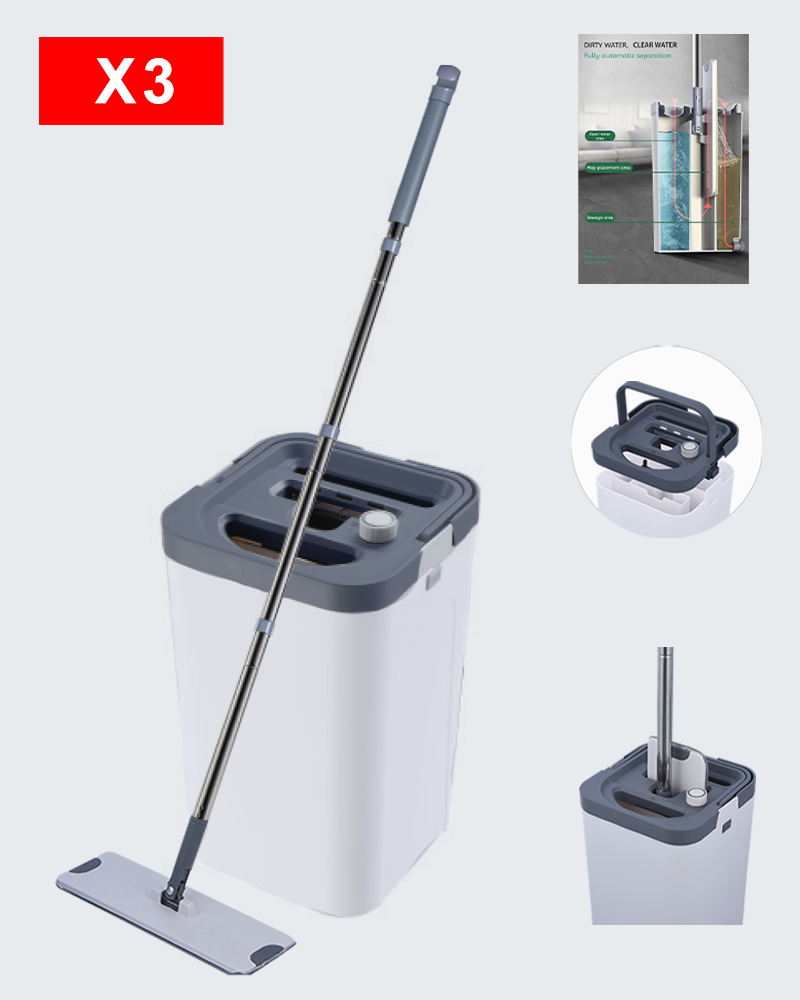
The bucket in a flat mop set is not simply a container for water — it is an engineered component. Most quality flat mop buckets feature a separation chamber system that keeps clean water and dirty water apart during use, a pressing or spinning mechanism that wrings the mop pad without hand contact, and wheels or a compact footprint for easy positioning around the home.
Complete sets are designed so that the mop, pad, and bucket work as a coordinated system — the pad dimensions match the wringer slot precisely, the handle length suits the bucket ergonomics, and the water capacity is calibrated for typical room-by-room cleaning tasks.
Key Advantages That Make Flat Mop Bucket Sets Worth Using
Hands-Free Wringing Keeps Cleaning Hygienic
One of the most appreciated features of a well-designed flat mop bucket set is the ability to wring out the mop pad without touching it. The foot-operated or handle-press wringer mechanism allows users to control moisture content in the pad without bending, squeezing, or hand-contact with dirty mop water. This is particularly important for households with young children, elderly users, or anyone with hand or back mobility concerns. Hands-free wringing also reduces cross-contamination — a genuine hygiene benefit that traditional string mops cannot match.
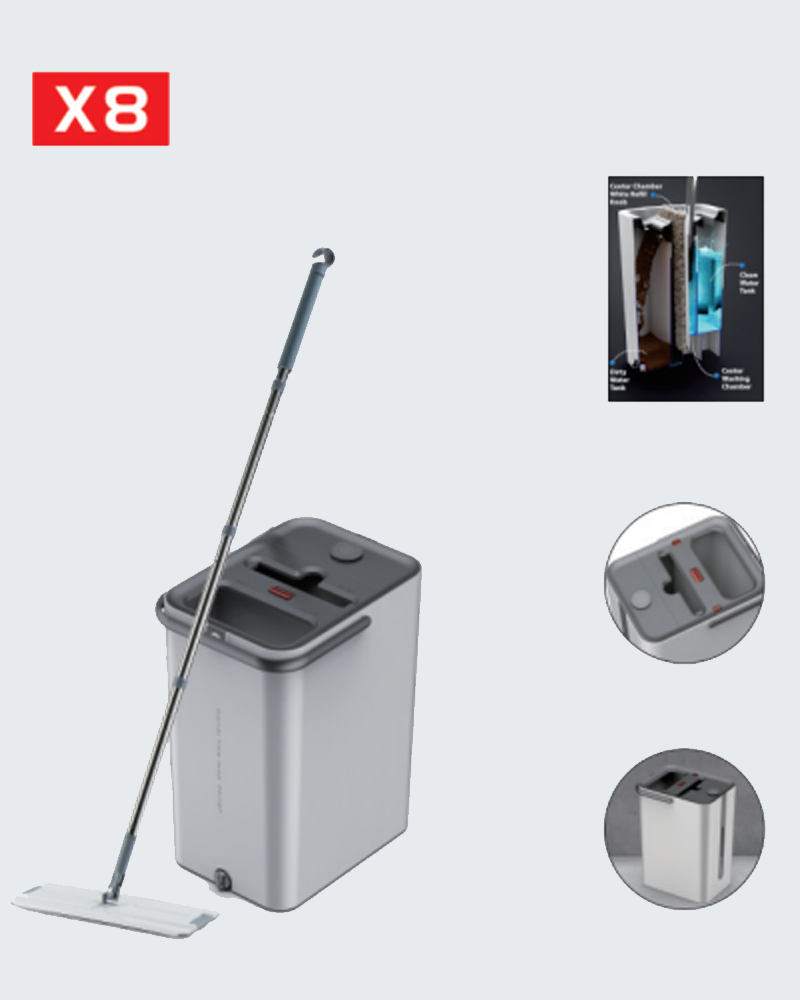
Clean/Dirty Water Separation Produces Better Results
Premium flat mop bucket sets incorporate a "cleaning separation" design — often referred to as a dual-chamber or clean-separation bucket — that physically separates the clean rinse water from the dirty water collected from the floor. This means the mop pad is always rinsed with clean water rather than being reintroduced to soiled water, which is the fundamental problem with single-bucket mopping systems.
The practical result is that floors are cleaned with consistently clean water throughout the mopping session, rather than being re-coated with diluted dirty water as the session progresses. Users who have switched from traditional systems often report visibly cleaner floors and less residue, particularly on light-colored or polished flooring.
Flat Head Design Covers More Floor Area Per Stroke
A typical flat mop head measures between 40 cm and 50 cm in width, compared to a traditional string mop head which effectively covers a much narrower path. The flat head lies entirely in contact with the floor at all times, meaning every centimeter of the pad is actively cleaning — unlike a round string mop which contacts the floor unevenly through its twisted strands. This wider, flatter contact allows users to clean the same floor area in fewer strokes and in less time.
The flat design also enables cleaning under low-clearance furniture — sofas, beds, kitchen cabinets — that a bulky round mop head cannot access. This is a genuine practical advantage that many users cite as their primary reason for switching to a flat mop system.
Microfiber Pads Clean More Effectively at Lower Temperatures
Quality flat mop sets use microfiber pads that consist of extremely fine fibers — typically less than 1 micron in diameter, which is approximately 1/100th the diameter of a human hair. These fine fibers create an enormous surface area within the pad, enabling it to trap and hold dirt particles, bacteria, and fine dust rather than simply pushing them around. Microfiber pads are effective at capturing particles with plain water alone, reducing the need for strong cleaning chemicals. Studies on microfiber cleaning systems have found them capable of removing up to 99% of bacteria from hard surfaces using water only.
Reusable and Machine-Washable Pads Reduce Ongoing Cost
Unlike disposable mop systems that require regular pad purchases, most flat mop bucket sets come with washable microfiber pads that can withstand 300–500 machine wash cycles before performance degrades noticeably. This makes flat mop sets more economical over their lifespan and significantly more environmentally responsible than disposable alternatives. Replacement pads are also widely available and easy to install — typically via velcro attachment or a simple snap-fit system.
Ergonomic Handle Design Reduces Physical Strain
Quality flat mop sets feature extendable, often telescoping handles that allow users to adjust the length to their height, eliminating the stooped posture that causes back strain with fixed-length mops. The flat head pivots at the connection point, allowing the mop to follow the natural swing of the arm without requiring the user to twist their wrist or body. Users with back problems consistently rate flat mop systems as more comfortable than traditional mops for extended cleaning sessions.
Flat Mop Bucket Set vs. Traditional Mop and Bucket: A Direct Comparison
To understand the value of a flat mop bucket set, it helps to compare it directly against the traditional string mop and single-bucket system that most households have used for decades.
| Factor | Flat Mop Bucket Set | Traditional String Mop & Bucket |
|---|---|---|
| Cleaning Speed | Faster — wider head, fewer strokes needed | Slower — narrow effective cleaning path |
| Water Hygiene | Clean/dirty separation in premium sets | Single bucket; mop reintroduced to dirty water |
| Hand Contact with Dirty Water | None — hands-free wringing mechanism | Often required to wring or adjust mop head |
| Reaching Under Furniture | Excellent — low-profile flat head | Poor — bulky round head cannot access tight spaces |
| Floor Drying Time | Faster — wringing leaves pad damp, not wet | Slower — string mops often leave excess water |
| Ergonomics | Better — adjustable handle, pivoting head | Fixed handle; requires awkward twisting motion |
| Pad Maintenance | Machine washable — 300–500 wash cycles | Difficult to clean thoroughly; harbors bacteria |
| Storage | Compact — flat head folds or stores easily | Bulky round head; difficult to store hygienically |
What Floor Types Are Flat Mop Bucket Sets Suitable For?
A well-designed flat mop bucket set is suitable for the majority of hard floor surfaces found in modern homes and commercial spaces. Understanding which surfaces benefit most — and which require specific considerations — helps you get the best results from your flat mop system.
| Floor Type | Suitability | Recommended Pad Moisture Level | Notes |
|---|---|---|---|
| Ceramic / Porcelain Tile | Excellent | Damp to wet | Ideal surface; grout lines benefit from microfiber |
| Laminate Flooring | Very Good | Damp only — avoid excess water | Well-wrung pad prevents moisture damage to joints |
| Hardwood / Engineered Wood | Good | Slightly damp — minimal moisture | Use flat mop's wringing precision to keep pad nearly dry |
| Vinyl / LVT / SPC | Excellent | Damp to wet | Waterproof surface; no moisture restrictions |
| Marble / Natural Stone | Good | Damp | Use pH-neutral cleaning solution; microfiber is gentle |
| Concrete (Sealed) | Very Good | Damp to wet | Flat head efficient on large open areas |
What to Look for in a Good Flat Mop Bucket Set
Not all flat mop bucket sets deliver the same experience. The quality of individual components determines whether a set performs reliably for years or disappoints within months. Here are the features that genuinely matter:
Bucket Design: Clean Separation System
The best flat mop buckets use a dual-chamber or clean-separation design that keeps clean and dirty water physically separated. When you press the mop pad into the wringer slot, dirty water is channeled into a separate collection section. Fresh water from the clean chamber is then used to rinse and re-wet the pad. This system means you are always mopping with clean water, rather than repeatedly introducing the dirty pad back into your wash water. Buckets that lack this feature are essentially standard buckets with a wringer attached — a meaningful step up from a string mop, but not as effective as a true clean-separation system.
Wringer Mechanism: Durability and Ease of Operation
The wringer is one of the most mechanically stressed components in the system. Look for wringers built from high-impact PP (polypropylene) or ABS plastic with reinforced hinge points. The pressing mechanism should require minimal force to operate — a well-designed press wringer should wring a fully saturated pad with one moderate foot or hand press. Poorly designed wringers require excessive force, break within weeks of use, or leave the pad too wet, which defeats the purpose of controlled moisture mopping.
Mop Head: Size, Pivot Range, and Pad Attachment
A mop head width of 40–50 cm is practical for most home rooms. The head should pivot through at least 180 degrees to allow flat cleaning under furniture and in corners without repositioning the user. Pad attachment should be secure during use but easy to remove for washing — velcro is the most common system and works well; snap or clip systems are more robust but less convenient for quick pad changes. Verify that replacement pads are readily available for the specific model you purchase.
Handle: Length Adjustment and Locking Mechanism
A quality telescoping handle should adjust smoothly and lock firmly at any extension point. The locking mechanism (twist-lock, button-release, or push-button collar) must not slip under the normal downward and lateral pressure of mopping. Handle length range of 90 cm to 130 cm accommodates users from approximately 155 cm to 185 cm in height, allowing an upright mopping posture without back strain.
Microfiber Pad Quality: GSM and Fiber Type
Microfiber pad quality is measured by GSM (grams per square meter) — the weight of the fabric. Higher GSM pads contain more fiber per area and are more absorbent and more durable. A quality flat mop pad should have a GSM of at least 200–300 g/m² for effective cleaning. The fiber split ratio also matters — split microfiber (where each fiber is divided into multiple wedge-shaped sub-fibers) is far more effective at trapping particles than unsplit round fibers. Premium pads use an 80/20 polyester/polyamide blend with high fiber split ratios.
Bucket Capacity and Stability
A bucket capacity of 8–12 liters is practical for most home cleaning sessions — large enough to clean a medium-sized home without refilling, compact enough to carry and store easily. The bucket base should be wide and weighted at the bottom to prevent tipping when the mop is pressed into the wringer under force. Look for rubber feet on the bucket base that prevent sliding on hard floors during wringing.
Who Benefits Most from a Flat Mop Bucket Set?
While virtually any household can benefit from a flat mop bucket set, certain users and situations see particularly pronounced improvements over traditional cleaning methods:
- Busy families — The speed advantage of a wide flat head combined with hands-free wringing means daily or frequent mopping takes significantly less time. Households with children or pets that require frequent floor cleaning particularly benefit from the efficiency.
- Households with large floor areas — Open-plan living spaces, long hallways, and large kitchen or dining areas are cleaned much faster with a flat mop's wide head. What might take 30 minutes with a string mop can often be completed in under 15 minutes with a quality flat mop set.
- Users with back, knee, or hand limitations — The ergonomic handle, absence of manual wringing, and lightweight design make flat mop sets far more accessible for users with physical limitations than traditional heavy string mops.
- Laminate and hardwood floor owners — These floor types are sensitive to excess moisture. The flat mop's wringing precision allows users to achieve the exact damp-not-wet pad condition that protects wood-based floors, which is difficult to achieve consistently with a string mop.
- Allergy and hygiene-conscious households — Microfiber pads capture fine dust, allergens, and bacteria at much higher rates than cotton string mops. Combined with clean-separation water systems, flat mop sets are genuinely better for households where hygiene is a priority.
- Small apartments and compact spaces — The compact storage footprint of a flat mop set — compared to the bulky, dripping bundle of a traditional string mop — is a meaningful advantage in smaller living spaces where storage is limited.
How to Use a Flat Mop Bucket Set for Best Results
Even the best flat mop bucket set will underperform if used incorrectly. Following these steps ensures you get the most from your system with every cleaning session:
- Sweep or vacuum first. Remove loose debris, hair, and dry dirt before mopping. Mopping over loose debris reduces the effectiveness of the microfiber pad and deposits debris into the bucket water prematurely.
- Use the right water temperature. Warm water (40°C–50°C) activates microfiber more effectively than cold water and helps dissolve grease and sticky residues. Avoid very hot water (above 60°C) which can damage microfiber fibers and reduce pad longevity.
- Add cleaning solution sparingly. Microfiber pads are effective with plain water for most routine cleaning. If using a cleaning concentrate, follow dilution instructions carefully — excess detergent leaves residue on floors and causes the microfiber pad to load with soap, reducing its effectiveness.
- Wring the pad to the right moisture level for your floor type. For tile and vinyl, a damp-to-wet pad is fine. For laminate and hardwood, wring until the pad is just barely damp — it should not leave visible water on the floor surface.
- Use overlapping S-stroke or figure-eight technique. Rather than random strokes, work in overlapping passes across the room in an S-pattern. This ensures every section of the floor is covered and prevents leaving uncleaned strips between passes.
- Rinse and wring the pad frequently. In heavily soiled areas, rinse and wring the pad every 15–20 square meters to prevent redistribution of dirt. The clean-separation bucket system makes this fast and easy.
- Wash the pad after every use. Machine wash microfiber pads after each cleaning session at 40°C–60°C without fabric softener (softener clogs the microfiber channels and dramatically reduces cleaning effectiveness). Allow the pad to air dry or tumble dry on low heat.
Common Questions About Flat Mop Bucket Sets Answered
How often should I replace the microfiber mop pad?
A quality microfiber mop pad can withstand between 300 and 500 machine wash cycles before its cleaning performance noticeably declines. For a household that washes the pad weekly, this represents 6–10 years of use. Signs that a pad needs replacement include reduced absorbency, a stiff or matted feel after washing, visible wear or thinning of the pile, and an inability to release dirt during washing. Keeping one or two spare pads on hand allows you to continue cleaning while a pad is in the wash.
Is it safe to use a flat mop on hardwood floors?
Yes, with the correct moisture control. The key advantage of a flat mop bucket set for hardwood floors is the ability to precisely control how wet the pad is. A properly wrung microfiber pad that is damp but not wet will not damage sealed hardwood or engineered wood floors. Avoid leaving water pooled on the surface, and never use a soaking-wet pad on wood floors. The flat mop's wringer mechanism makes achieving the right moisture level far more consistent than trying to hand-wring a string mop.
Can I use a flat mop bucket set for commercial or office spaces?
Yes — flat mop bucket sets are effective in commercial settings, particularly for office spaces, retail environments, and hospitality cleaning where hard floors are predominant and appearance standards are high. For very large commercial areas, professional-grade flat mop systems with larger bucket capacities and heavy-duty frame construction are available. The core benefits — speed, hygiene, and reduced physical effort — apply equally in commercial and residential contexts.
What cleaning solutions can I use with a flat mop?
Most standard hard floor cleaning concentrates are compatible with flat mop bucket sets. For daily cleaning, plain warm water is often sufficient with a quality microfiber pad. For disinfection, dilute disinfectant solutions compatible with your floor type can be added to the clean water chamber. Avoid bleach-based solutions with colored microfiber pads (they cause fading) and avoid oil-based cleaners that can clog microfiber channels. Never use fabric softener when washing the pads — it permanently reduces their cleaning effectiveness.
How do I prevent the bucket from smelling after use?
Empty the dirty water from the bucket immediately after each cleaning session rather than leaving it to stand. Rinse the bucket interior, wringer mechanism, and any removable chambers with clean water and allow to air dry completely before storage. Storing a wet bucket with residual dirty water is the primary cause of mold growth and odor. A 5-minute post-cleaning rinse routine eliminates odor problems entirely and extends the life of the bucket components.
Flat Mop Bucket Set Maintenance and Longevity Tips
A flat mop bucket set is a durable product when maintained correctly. Simple habits can extend the service life of both the mop and bucket components significantly:
- Remove the mop pad before storage — leaving a damp pad attached to the mop head promotes mold and mildew growth on both the pad and the head frame.
- Inspect the handle locking mechanism periodically — tighten any loose collars or replace worn lock buttons before they cause the handle to slip during use.
- Lubricate the wringer hinge annually — a small amount of silicone-based lubricant on the wringer hinge points prevents stiffness and extends the mechanical life of the pressing mechanism.
- Check the mop head pivot joint — the swivel connection between the mop head and handle is subject to repeated stress. Clean any debris from the joint and ensure it moves freely through its full range of motion.
- Store the system assembled but dry — a fully assembled flat mop set takes up no more space than a traditional mop and can be stored standing in a utility closet or against a wall. Ensure all components are dry before closing the storage space to prevent moisture buildup.
About Ningbo Yaxiang Cleaning Products Co., Ltd.
Ningbo Yaxiang Cleaning Products Co., Ltd. was established in 2008 and has grown into a leading professional OEM and ODM manufacturer of flat mop bucket sets and home cleaning products in China. The company's independently developed MOP X "cleaning separation" series — which embodies the clean/dirty water separation technology described throughout this article — has been granted more than 40 national patents, reflecting the depth of innovation invested in this product category.
Yaxiang's products are sold in more than 50 countries across Europe, America, Japan, South Korea, and beyond, and the company holds ISO9001 and BSCI quality and social responsibility certifications. With over fifteen years of dedicated focus on home cleaning product development, Yaxiang's business philosophy of "professional, efficient, innovative and win-win" drives continuous product improvement in pursuit of exceeding customer expectations — whether those customers are global retailers, distributors, or the end consumers who use these products in their homes every day.