
 English
 Español
 中文简体
中文简体
Content
- 1 Cleaning Performance: How Each System Actually Cleans
- 2 Hygiene: Which System Is Cleaner to Use?
- 3 Floor Drying Time: An Overlooked but Practical Difference
- 4 Ergonomics and Physical Ease of Use
- 5 Cost Comparison: Purchase Price, Running Costs, and Lifespan
- 6 Performance by Floor Type: Which Mop Suits Which Surface
- 7 Speed and Efficiency: Which Gets the Job Done Faster
- 8 Environmental Impact: Sustainability Comparison
- 9 When a Traditional Mop Is Still the Better Choice
- 10 Side-by-Side Summary: Flat Mop Bucket Set vs Traditional Mop
- 11 The Final Recommendation: Who Should Choose Which
For most households and light commercial environments, a flat mop bucket set is the better choice. It cleans more hygienically, dries floors faster, is physically easier to use, and performs significantly better on hard smooth floor surfaces — which make up the majority of modern flooring. A traditional string or sponge mop with a wringer bucket retains its advantage only in specific situations: heavily textured floors, large-scale deep scrubbing tasks, and environments where extremely low upfront cost is the overriding priority.
That said, "better" depends entirely on your floor types, cleaning frequency, physical requirements, and budget. The sections below break down every meaningful comparison category — cleaning performance, hygiene, speed, ergonomics, cost, and suitability by floor type — so you can make a fully informed decision rather than a general one.
Cleaning Performance: How Each System Actually Cleans
Cleaning performance is the most important category, and it is where the two systems differ most significantly in mechanism — not just in result.
How a Flat Mop Cleans
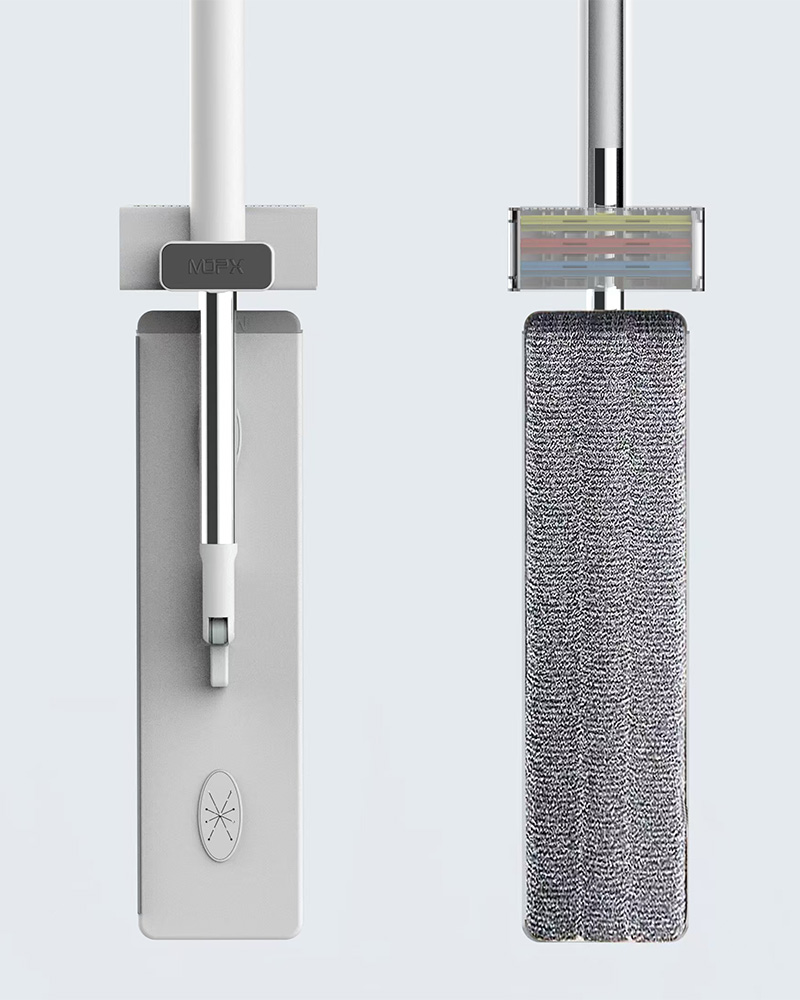
A flat mop with a microfiber pad cleans through mechanical capture and absorption. The split microfiber strands — each typically less than 1/100th the diameter of a human hair — create millions of tiny hooks that physically grab and hold dust particles, bacteria, and liquid soils within the fiber structure rather than pushing them across the floor. The flat, low-profile head lies flush against the floor surface, maintaining full pad contact across its entire width with every stroke.
Research comparing microfiber flat mops to traditional mops on hard floor surfaces has found that microfiber flat mops remove up to 99% of surface bacteria with plain water alone, compared to traditional cotton mops which typically achieve 30–40% bacterial removal without disinfectant. This difference stems from the mechanical trapping action of microfiber versus the smearing action of loosely twisted cotton strands.
How a Traditional Mop Cleans
A traditional string or looped cotton mop cleans primarily through dissolution and dilution — the large volume of soapy water it applies to the floor loosens soils, which are then absorbed into the mop strands and partially removed when the mop is wrung out. The cleaning action relies heavily on the chemical action of the cleaning solution rather than the mechanical action of the mop fibers themselves.
This approach works reasonably well on heavily soiled surfaces where large amounts of water are needed to dissolve and flush away soils — outdoor concrete, rough stone, workshop floors — but on smooth indoor surfaces, it frequently results in a thin layer of diluted dirty water being spread across the floor, which dries to leave a dull, streaky film.
Reach Under Furniture
The flat, low-profile head of a flat mop — typically only 8 to 12 cm in height combined with a 360° swivel joint — slides effortlessly under beds, sofas, kitchen cabinets, and bathroom vanities. A traditional string mop's bulky, rounded head cannot reach under most furniture at all, leaving a permanent ring of uncleaned floor under every piece of furniture in the room.
Hygiene: Which System Is Cleaner to Use?
Hygiene is one of the most underappreciated differences between the two systems, and it consistently favors the flat mop bucket set when used correctly.
Bacterial Contamination in the Bucket
Every time a traditional string mop is returned to its bucket after mopping a floor section, it deposits the soil and bacteria it has just collected from the floor directly back into the cleaning water. Studies of traditional mop water conducted in healthcare and food service environments have found that bucket water can contain bacterial concentrations exceeding 10 million colony-forming units per milliliter (CFU/mL) after cleaning just a small area — effectively using contaminated water to mop the remainder of the floor.
Flat mop bucket systems address this problem through their design: the mop pad is pressed through a wringer mechanism that extracts water from the pad and returns it to the bucket, but the pad does not submerge and stir the dirty water each time it is re-wetted. While the bucket water still becomes contaminated over time, the degree of re-contamination per dip is significantly lower, and the flat mop pad system makes it easier and faster to change the bucket water frequently.
Mop Head Drying and Odor
Traditional string mop heads — particularly cotton ones — hold large volumes of water within their twisted or looped fiber mass. After use, this water-laden head takes many hours to dry, and if stored in a bucket or mop sink, it may remain damp for 12 to 24 hours or longer. This sustained moisture creates an ideal environment for bacterial proliferation and mold growth, which is why traditional mop heads develop a characteristic unpleasant odor relatively quickly — often within days of first use in warm environments.
Flat microfiber mop pads dry substantially faster than cotton string mops. When removed from the mop frame after use, rinsed, and hung flat or draped over a railing, a microfiber pad typically dries completely within 1 to 3 hours at room temperature. This rapid drying dramatically reduces bacterial growth between uses and extends the period before odor development becomes noticeable.
Washability and Sanitization
Microfiber flat mop pads are fully machine washable at 40°C to 60°C, which is sufficient to kill common household pathogens and restore the pad to a hygienic starting state for the next use. Traditional cotton string mop heads can also be machine washed, but their bulk, weight when wet, and tendency to tangle make machine washing inconvenient — and many users simply rinse them under running water rather than laundering them properly, leaving embedded soils and bacteria in the fiber mass.
Floor Drying Time: An Overlooked but Practical Difference
How quickly a floor dries after mopping affects practical usability of the space, slip hazard risk, and — for sensitive floor materials like wood and laminate — the amount of moisture exposure the floor surface sustains with each cleaning session.
A well-wrung flat mop pad leaves a thin, even film of moisture on the floor surface that typically evaporates within 3 to 8 minutes at normal indoor temperatures and humidity. A traditional string mop, even after wringing, typically applies significantly more water to the floor — a soaked string mop can hold 3 to 5 times more water than a flat mop pad of equivalent size — resulting in drying times of 15 to 30 minutes or more for smooth floors, and potentially much longer in grout lines, surface texture, or at floor edges where water pools.
For wood and laminate floors, this difference is not just a convenience issue — it is a material preservation issue. Extended water contact on wood causes progressive fiber swelling, adhesive softening under laminate planks, and finish degradation. The faster drying time of the flat mop system directly translates into reduced cumulative moisture damage on moisture-sensitive flooring over months and years of cleaning.
Ergonomics and Physical Ease of Use
For many users — particularly older adults, people with back or joint conditions, or anyone who mops large areas regularly — the physical demands of each mopping system are a primary selection factor.
Weight and Maneuverability
A wet traditional string mop head can weigh 800 grams to over 1.5 kg when fully saturated — and lifting this weight repeatedly during a cleaning session, combined with the wringing effort required to squeeze out a large mop head, generates significant cumulative physical strain on the wrists, shoulders, and lower back. The flat mop pad, by contrast, weighs only 200 to 400 grams even when wet, and the wringer mechanism on most flat mop bucket sets requires only light downward pressure on a lever or pedal — no manual twisting or heavy squeezing needed.
The flat mop head's low center of gravity and swivel joint also make it significantly easier to maneuver around furniture and into corners without lifting or repositioning. Pushing a flat mop is a smooth, gliding motion that uses body weight naturally; traditional string mopping requires more active arm effort to push the heavier, resistant mop head across the floor.
Wringing Mechanism Comparison
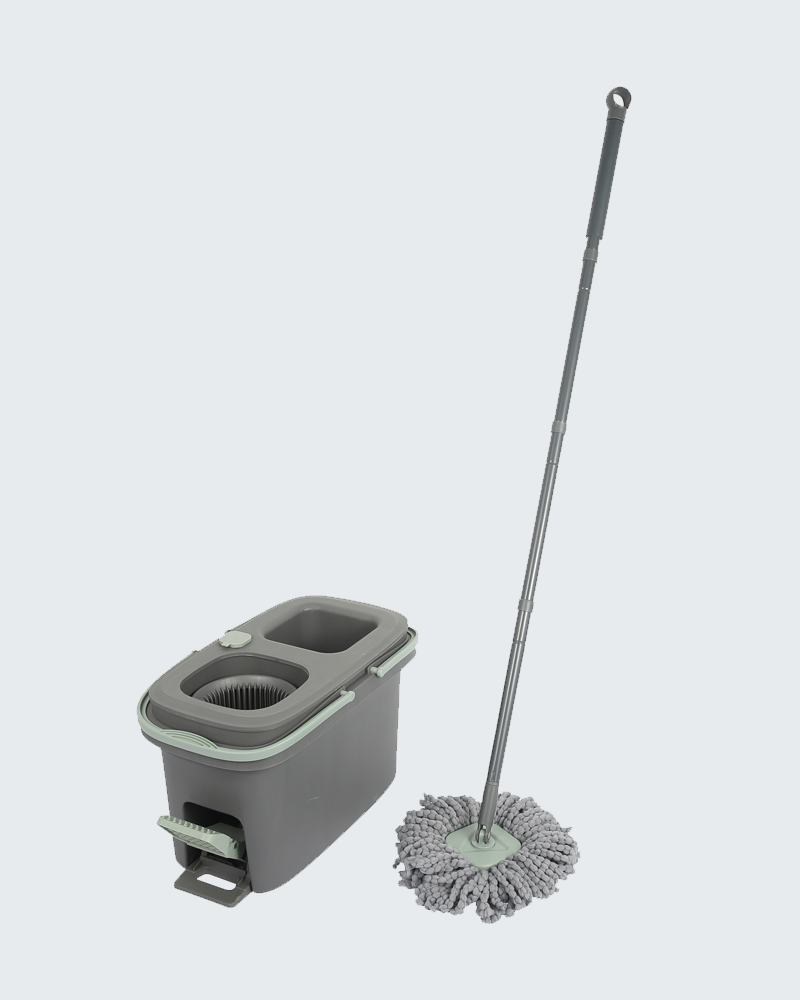
Traditional mop buckets with round wringer mechanisms require the user to press or twist the mop head through a plastic or rubber wringer — an action that demands grip strength and repeated wrist rotation, which can be uncomfortable or difficult for users with arthritis or reduced hand strength. Flat mop bucket sets with pedal-operated press plates allow the user to apply wringer pressure using their foot and body weight rather than their hands — a significant ergonomic advantage for extended cleaning sessions.
Storage Footprint
Traditional mop and bucket combinations are typically stored vertically — the mop head up or down in a corner — which requires a height of 150 cm or more and a floor footprint for the bucket. Flat mop systems store more compactly: the mop head lies flat and the handle folds or removes, allowing the entire system to be stored in a cupboard on its side or hung on a wall hook. The bucket, being rectangular rather than round, also stacks or stores more efficiently in tight utility spaces.
Cost Comparison: Purchase Price, Running Costs, and Lifespan
Cost comparison between the two systems needs to account for both the initial purchase and ongoing running costs over a realistic ownership period — typically 2 to 5 years for domestic use.
| Cost Category | Flat Mop Bucket Set | Traditional Mop and Bucket |
|---|---|---|
| Initial purchase (mid-range quality) | $25 – $60 | $10 – $30 |
| Replacement pad / mop head frequency | Every 6–12 months (machine washable) | Every 2–4 months (degrades faster) |
| Replacement consumable cost | $5 – $15 per pad | $4 – $12 per mop head |
| Estimated consumable spend over 3 years | $15 – $45 (3–5 pad replacements) | $36 – $108 (9–12 head replacements) |
| Cleaning solution usage | Lower — effective with less chemical | Higher — relies more on chemical action |
| Estimated total 3-year cost | $40 – $105 | $46 – $138 |
Over a 3-year period, the total cost of ownership for a flat mop bucket set is typically equal to or lower than a traditional mop and bucket despite the higher upfront price — primarily because microfiber pads last significantly longer than cotton string mop heads and require fewer replacement cycles. The gap widens further when reduced cleaning solution consumption is factored in.
Performance by Floor Type: Which Mop Suits Which Surface
Neither system outperforms the other on every floor type. The table below summarizes the relative suitability of each system across the most common domestic and light commercial floor surfaces.
| Floor Type | Flat Mop Bucket Set | Traditional Mop | Recommended Choice |
|---|---|---|---|
| Hardwood / Engineered Wood | Excellent — precise moisture control, no excess water | Poor — too much moisture, risk of warping | Flat mop |
| Laminate | Excellent — damp-dry application protects seams | Poor — excess moisture damages plank joints | Flat mop |
| Vinyl / LVT | Excellent — gentle, effective, fast drying | Good — tolerates more water but leaves streaks | Flat mop |
| Smooth Ceramic / Porcelain Tile | Excellent — streak-free, reaches grout edges | Good — adequate but leaves more residue | Flat mop |
| Heavily Textured / Quarry Tile | Moderate — pad may not reach deep texture valleys | Good — string fibers penetrate texture better | Traditional mop |
| Natural Stone (Marble, Slate) | Excellent — gentle, low moisture, no streaks | Moderate — risk of over-wetting porous stone | Flat mop |
| Concrete / Outdoor Pavers | Poor — pad clogs with heavy grit, not enough water | Excellent — handles heavy soiling and large water volumes | Traditional mop |
Speed and Efficiency: Which Gets the Job Done Faster
For regular domestic cleaning — mopping a kitchen, bathroom, and hallway in a typical home — a flat mop bucket set is measurably faster than a traditional mop setup. The primary time savings come from three sources:
- Wider effective coverage per stroke: A flat mop head is typically 40 to 60 cm wide and lies completely flat on the floor, covering its full width with every stroke. A traditional string mop of equivalent nominal width only contacts the floor with the dangling mop strands, which bunch and separate during mopping — effective contact width may be only 50 to 70% of the stated mop width.
- Faster wringing: Pressing a flat mop pad through a lever or pedal wringer takes 2 to 3 seconds. Twisting or pressing a heavy string mop through a traditional wringer takes 5 to 10 seconds and requires more physical effort — a difference that accumulates significantly over a full room mopping session with multiple re-wring cycles.
- No re-mopping due to over-wetting: A correctly wrung flat mop pad leaves the floor clean and nearly dry in a single pass. Traditional mops often leave enough moisture that a second dry pass or extended drying period is needed, especially in corners and along baseboards where water pools.
For a typical 20 m² kitchen and dining area, an experienced user with a flat mop bucket set can complete the full mopping task — including bucket setup, mopping, and cleanup — in approximately 8 to 12 minutes. The same area with a traditional string mop typically takes 15 to 20 minutes when accounting for slower wringing, reduced maneuverability around furniture, and the additional drying time before the space is usable again.
Environmental Impact: Sustainability Comparison
Environmental considerations increasingly factor into household product decisions. Both systems have environmental implications worth considering.
Water Consumption
Flat mop systems use significantly less water per cleaning session than traditional mops. A flat mop bucket is typically filled with 8 to 12 liters of water — and because the pad requires less re-dipping and the damp cleaning technique is effective, this single bucket of water often suffices for a complete mopping session in a medium-sized home. A traditional mop and its larger round bucket holds 10 to 15 liters and often requires refilling once or twice during the same session due to faster water contamination from the heavier mop head stirring dirt back into the water. Over a year of weekly mopping, the water savings from a flat mop system can amount to several hundred liters.
Cleaning Chemical Usage
Because microfiber flat mop pads are effective at removing soils with minimal chemical assistance — often with plain water alone for light maintenance cleaning — households that switch from traditional to flat mopping typically use 30 to 50% less floor cleaning solution per year. This reduction in chemical use means less chemical manufacturing, less packaging waste, and less chemical discharged to the water system with wastewater.
Waste Generation
Traditional cotton string mop heads are replaced every 2 to 4 months under typical household use, generating 3 to 6 discarded mop heads per year — each consisting of cotton fibers bonded to a plastic core or metal band that is difficult to recycle. Microfiber flat mop pads, replaced only once or twice per year and lasting up to 500 wash cycles, generate significantly less solid waste over equivalent time periods. However, it should be noted that microfiber pads release microplastic fibers during washing — a genuine environmental concern that traditional cotton mops do not share.
When a Traditional Mop Is Still the Better Choice
Despite the flat mop's advantages in most categories, traditional mops retain a genuine advantage in specific scenarios. Choosing a traditional mop makes more sense when:
- Floors are heavily textured: Outdoor concrete, rough quarry tile, anti-slip commercial flooring, and cobblestone surfaces have deep surface profiles that string mop fibers penetrate more effectively than a flat pad. The dangling strands of a string mop reach into recesses that a flat pad simply cannot contact.
- Large volumes of water are needed for flushing: Workshop floors, garage floors, and outdoor covered areas where heavy soil or spills need to be flushed toward a drain benefit from the large water volume that a traditional mop applies. A flat mop's damp-cleaning technique is not designed for high-volume water flushing tasks.
- Budget is the primary constraint: A basic traditional mop and bucket can be purchased for as little as $8 to $15 — significantly less than a quality flat mop bucket set. For households where upfront cost is the overriding factor, the traditional mop remains accessible at price points that flat mop systems do not match.
- Cleaning very large commercial spaces with heavy soiling: In commercial settings such as industrial kitchens, locker rooms, or wet markets where floors are cleaned with high-volume water applications and strong cleaning agents, professional-grade traditional mop setups with large capacity buckets can be more practical than flat mop systems whose pads would need frequent changing.
Side-by-Side Summary: Flat Mop Bucket Set vs Traditional Mop
The following summary table consolidates all comparison categories to provide a quick reference for the most important decision factors.
| Category | Flat Mop Bucket Set | Traditional Mop | Winner |
|---|---|---|---|
| Cleaning performance (smooth floors) | Up to 99% bacteria removal with plain water | 30–40% bacteria removal without disinfectant | Flat mop |
| Hygiene | Lower cross-contamination, fast-drying pad | High re-contamination risk from bucket water | Flat mop |
| Floor drying time | 3–8 minutes | 15–30 minutes | Flat mop |
| Ergonomics / physical ease | Lightweight, pedal wringer, swivel head | Heavier, manual twisting, limited reach | Flat mop |
| Reach under furniture | Excellent — low-profile swivel head | Poor — bulky head cannot reach under most furniture | Flat mop |
| Upfront purchase cost | $25–$60 | $10–$30 | Traditional mop |
| 3-year total cost | $40–$105 | $46–$138 | Flat mop (slight edge) |
| Wood and laminate floors | Excellent | Poor | Flat mop |
| Heavily textured / outdoor floors | Poor | Good to Excellent | Traditional mop |
| Speed (medium room, 20 m²) | 8–12 minutes | 15–20 minutes | Flat mop |
| Water consumption per session | Lower — 8–12 liters typically sufficient | Higher — often requires refilling | Flat mop |
The Final Recommendation: Who Should Choose Which
Based on the evidence across all comparison categories, the following recommendations apply to the most common user situations:
- Choose a flat mop bucket set if you have hardwood, laminate, vinyl, tile, or natural stone floors; you want a faster, lighter, and more hygienic cleaning experience; you have any joint or back conditions that make heavy wringing uncomfortable; or you want to reduce cleaning chemical and water consumption over time.
- Choose a traditional mop if you primarily clean rough-textured outdoor or workshop floors; you need to flush large volumes of water across a surface; your budget is under $15 and you cannot stretch to a flat mop system; or you are cleaning surfaces where the flat pad would clog rapidly with heavy grit or debris.
- Consider owning both if your home includes a mix of indoor smooth flooring and textured outdoor or utility areas — a flat mop for indoor day-to-day cleaning and a traditional mop for garage, patio, or workshop cleaning gives you the best tool for each surface without compromise.
For the majority of modern homes with a mix of wood, tile, and vinyl flooring, the flat mop bucket set is the objectively superior cleaning system in every category that matters most — hygiene, surface care, ergonomics, speed, and total lifecycle value. The slightly higher purchase price is recovered within the first year through reduced mop head replacement frequency and lower cleaning chemical consumption alone.