
 English
 Español
 中文简体
中文简体
Content
- 1 Start With the Answer: the Wash Water Is Usually the Problem
- 2 Why One Bucket Cannot Stay Clean for a Whole Room
- 3 The Mop Head Is a Reservoir, Not Just a Tool
- 4 Too Much Water, the Wrong Cleaner, and the Film Left Behind
- 5 Choose Equipment That Removes the Cause
- 6 A Mopping Routine That Leaves Nothing Behind
Ten minutes after the last pass, the floor looks worse than it did before you started. A grey haze sits over the tiles, and bare feet leave dark prints within an hour. The surface is not dirty because you did not scrub hard enough. In most homes the floor is still dirty after mopping because the mop has been spreading a thin layer of contaminated water across the whole room, one pass at a time.
When that water evaporates, everything it carried stays behind: fine soil, kitchen oil, detergent residue and the minerals that were already in the tap water. What you see afterwards is a film rather than fresh dirt, which is why a clean cloth wiped over part of the floor often reveals a lighter patch in the middle of an otherwise dull surface.
Start With the Answer: the Wash Water Is Usually the Problem
Contaminated wash water explains most cases, followed by a mop head that never fully dries. Cleaner choice, water hardness and technique matter, but they usually sit on top of those first two causes instead of causing the problem alone.
The ranking above comes from repeated wash water checks and from feedback collected through buyers who resell these tools. Dirty water reused across a room comes first because a single bucket has no way to separate what comes off the floor from what goes back on it. A damp mop head ranks second, since fibers hold soil and give bacteria a wet place to multiply. Leaving too much water behind ranks third, and the residue dries into streaks that look like dirt. Using too much cleaner ranks fourth, because soap film attracts fresh soil quickly. Hard water minerals are the smallest single factor, yet they are the first thing you notice on dark tile and glossy stone.
Why One Bucket Cannot Stay Clean for a Whole Room
A single bucket works as a closed loop. The mop lifts soil from the floor, you rinse it in the bucket, the soil moves into the water, and the same mop soaks that water back up before touching the floor again. From the second pass onward you are diluting dirt and spreading it evenly across the room.
Splitting clean rinse water from dirty water breaks the loop, which is the working principle behind two-compartment bucket designs and the reason a dual compartment system keeps cross contamination out of the rinse stage.
The bars trace the quality of wash water across five passes with a single bucket, using a soil index where 100 marks the dirtiest water recorded in the test. The first pass is acceptable because both the mop and the water start clean. By the third pass the water carries enough suspended soil to leave a visible film once it dries on the tile. The dashed line shows the band that two-compartment systems normally stay inside, because dirty water is trapped or drained instead of being reused for rinsing. That single difference is why a separated bucket can finish a large room while the rinse water still looks reasonably clear. It also explains why adding more detergent makes things worse, since detergent keeps soil suspended so it spreads further instead of settling.
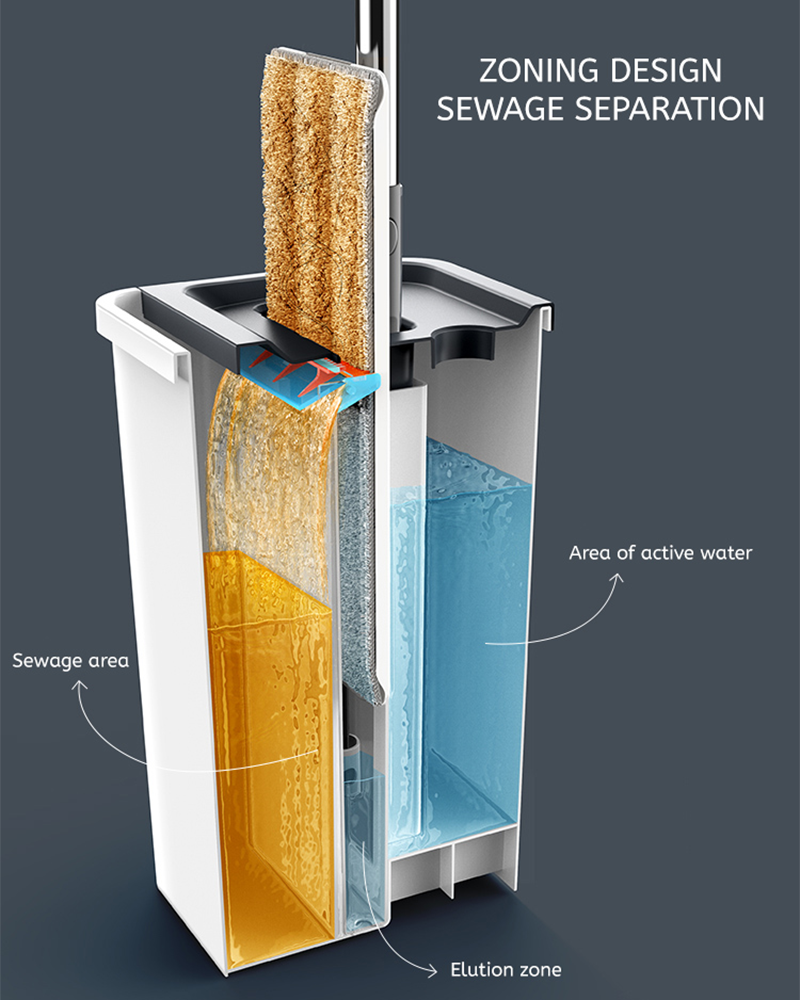 Clean And Dirty Water Separation Mop Bucket SetDescribe The Clean And Dirty Water Separation Mop Bucket Set is a cutting-edge floor cleaning solution designed to ensure maximum cleanliness and hygiene. With its adv...View Product →
The Mop Head Is a Reservoir, Not Just a Tool
Fibers absorb oil and fine dust, and a damp head left in a bucket or folded against a wall gives bacteria somewhere to grow. Debris also embeds deep in the pile where a quick rinse cannot reach it. The result is a mop that looks acceptable but releases a grey cloud into the water the moment it is wrung.
This chart follows two households across one week and tracks the residual soil left on the floor after each session. The lower line belongs to a head that is washed and dried after every use, and it stays almost flat because the tool never becomes a source of soil. The upper line belongs to a head that is wrung out and dropped back into the bucket while still damp, and it climbs steadily as biofilm and embedded debris build up. The gap between the lines is small on day one and wide by day seven, which is why a floor can seem to get dirtier over a week even though nothing in the routine changed. Washing or replacing the head resets the upper line back to the lower one, and that is the fastest single improvement available in most homes.
Mop head rules that matter
- Rinse the head in clean water, never in the water you have just used on the floor.
- Wring it to damp rather than dripping, so the floor dries in minutes instead of soaking grout lines.
- Wash reusable microfiber heads in hot water without fabric softener, which coats the fibers and reduces pickup.
- Dry the head flat or hanging, never compressed inside a closed bucket.
- Replace a flat mop pad once it stops springing back or leaves streaks even when it is clean.
 Hands Free Washing Mopx Flat Mop Bucket SetDescribe The Hands Free Washing Mopx Flat Mop Bucket Set offers an innovative cleaning solution designed for convenience and efficiency. This advanced set features a h...View Product →
Too Much Water, the Wrong Cleaner, and the Film Left Behind
Water is a carrier, not a cleaner. On sealed tile and laminate it sits in seams and grout, and when it evaporates it leaves dissolved minerals and detergent behind. A dripping mop is effectively painting the floor with a weak solution of everything you were trying to remove, and a neutral cleaner dosed at the low end of the label usually outperforms a strong one because excess surfactant turns sticky once dry.
| Symptom | Most likely cause | What to change |
|---|---|---|
| Grey haze across the whole floor | Detergent residue left unrinsed | Rinse with clean water and lower the dose |
| Streaks in the direction of the mop | Mop head too wet, water drying unevenly | Wring to damp, never dripping |
| Chalky white marks near grout | Hard water minerals left after evaporation | Use filtered water or dry the floor afterwards |
| Dark prints from bare feet | Thin oily film from soil or cleaner | Switch to a neutral cleaner and mop twice |
| Dull finish on glossy tile | Film build up from oil based shine products | Strip the film with a clean water rinse, then dry |
| Smell returns within a day | Biofilm inside the mop head | Wash the head in hot water and dry it fully |
Work down the list from the top, because the first three rows cover the majority of homes. A quick test is to mop one square meter with clean water only, let it dry, and look at the surface in daylight. If the haze returns there, the residue is coming from the mop or the water rather than from the floor itself.
Choose Equipment That Removes the Cause
Equipment cannot rescue a saturated mop head, but the right bucket removes the two largest causes at once, which are reuse of dirty water and hand contact with it.
The radar compares a flat mop paired with a two-compartment bucket against a traditional string mop used with a single bucket, scoring both on five practical points. On clean water kept in the bucket the separated system scores far higher, because rinse water is never mixed with the water that comes off the floor. On hand contact the gap is similar, since a hands free wringing mechanism keeps your hands out of the dirty water entirely. Drying speed and edge reach both favor the flat mop, which can be wrung drier and reaches along skirting boards and under low furniture. Water use is the closest of the five, because a two-compartment bucket needs a fresh fill for rinsing, yet it still uses less water than refilling a single bucket twice per room. The shape of the two polygons shows that separation systems win on the causes that matter most and give up almost nothing in return.
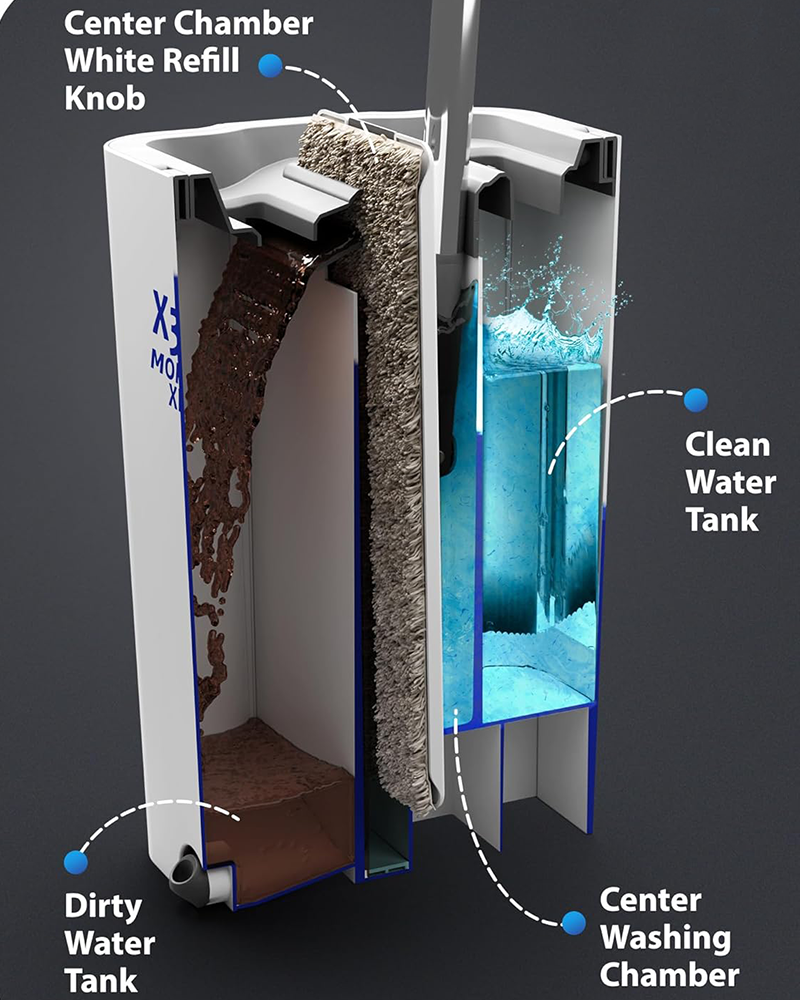 Professional Mopx Big Capacity Flat Mop Bucket SetDescribe The Professional Mopx Big Capacity Flat Mop Bucket Set is an exceptional cleaning tool designed for high-performance and heavy-duty cleaning needs. With its l...View Product →
Buyers comparing configurations can review the full range of flat mop bucket sets to match capacity, wringing method and cleaning separation features to a specific market.
A Mopping Routine That Leaves Nothing Behind
The order of these steps matters more than the effort applied to any single one.
- Remove loose dust and crumbs first with a dry pad or a vacuum, so the wet pass is not asked to do two jobs.
- Fill the rinse compartment with clean water and add a neutral cleaner at the low end of the recommended dose.
- Work backwards from the far corner to the door so you never walk across an area you have already cleaned.
- Mop in overlapping lanes about one head wide, turning the head as you go so a clean side faces the floor.
- Rinse the head only in the clean compartment and let the dirty water stay in the dirty compartment.
- Wring to damp and allow the floor to air dry, unless the surface is natural stone that needs a dry wipe.
- Empty the dirty compartment immediately, rinse the head, and dry both before storing them.
The sequence takes about the same time as the routine most people already follow. The difference is that the water touching the floor stays clean from the first pass to the last, and the mop stops returning soil to a surface you have already finished.
These habits solve the problem in a single home. In manufacturing, the same questions appear in a different form: how a mop head behaves after fifty wash cycles, whether a wringing mechanism still works after a thousand uses, and whether a bucket design keeps dirty water out of the rinse path when a user is in a hurry. MOP X has been building flat mops and bucket systems since 2008, with more than 40 national patents behind the cleaning separation series and ISO9001 and BSCI certification covering production and social compliance.
The factory sits roughly 50 kilometers from Ningbo Port and supplies more than 50 countries, running OEM and ODM projects with a typical lead time of about 30 days from order to shipment. A five person development team releases at least ten new products each year, which is how small problems reported by users turn into the next generation of bucket systems.