
 English
 Español
 中文简体
中文简体
Content
- 1 Superior Hygiene Through No-Touch Wringing
- 2 Flat Mop Head Design: More Coverage, Better Contact
- 3 Ergonomic Benefits: Protecting the User's Body
- 4 Versatility Across Floor Types and Cleaning Tasks
- 5 Moisture Control: Protecting Floors and Reducing Slip Risk
- 6 Durability and Material Quality: Built for Long-Term Use
- 7 Cleaning Efficiency: Covering More Ground in Less Time
- 8 Hands-Free Flat Mop vs. Traditional Mop: Direct Comparison
- 9 Storage and Portability Advantages
- 10 Environmental and Economic Benefits Over Time
- 11 Key Advantages Summary: What You Are Actually Getting
A hands-free flat mop bucket set offers cleaner floors, better hygiene, less physical strain, and faster cleaning compared to traditional string mops or basic bucket-and-wringer setups. The core advantages come from two innovations working together: a flat microfiber mop head that covers more surface area with less effort, and a pedal-operated or lever-activated wringer mechanism that wrings the mop without any hand contact. The result is a cleaning system that is more hygienic, more ergonomic, more efficient, and more versatile than anything available in a conventional mop-and-bucket combination.
These advantages are not purely theoretical. Studies on floor hygiene in healthcare and hospitality settings consistently show that flat microfiber mop systems reduce bacterial contamination on floor surfaces by up to 99% more effectively than traditional cotton string mops — a difference attributable to the microfiber material's ability to capture rather than merely redistribute bacteria and fine particles. The hands-free wringing mechanism reinforces this benefit by keeping the mop head free from hand-transferred contaminants throughout the cleaning session.
This article examines every major advantage of the hands-free flat mop bucket set in detail, supported by specific performance data and practical comparisons with conventional alternatives.
Superior Hygiene Through No-Touch Wringing
The defining feature of a hands-free flat mop bucket set is its wringing mechanism — typically a foot pedal, built-in press plate, or lever system that squeezes the mop pad dry without requiring the user to touch the mop head at any point. This seemingly simple design choice has significant hygiene implications.
Why Hand Contact Contaminates Cleaning
With a traditional string mop, wringing requires gripping and twisting the mop head directly. This transfers bacteria, cleaning chemicals, and soil from the saturated mop fibers onto the user's hands — and then, on the next contact, from the hands back onto the mop. Over the course of a cleaning session involving multiple wrings, this cross-contamination cycle progressively introduces new contaminants into the mop head and back onto the floor surface being cleaned.
The hands-free mechanism breaks this cycle entirely. Because the user's hands never touch the mop pad, no skin-borne bacteria or transferred soil enters the mop system during operation. The mop head remains in contact only with the floor and the clean water in the bucket — both controlled surfaces — throughout the entire cleaning process.
The Role of Dual-Compartment Water Separation
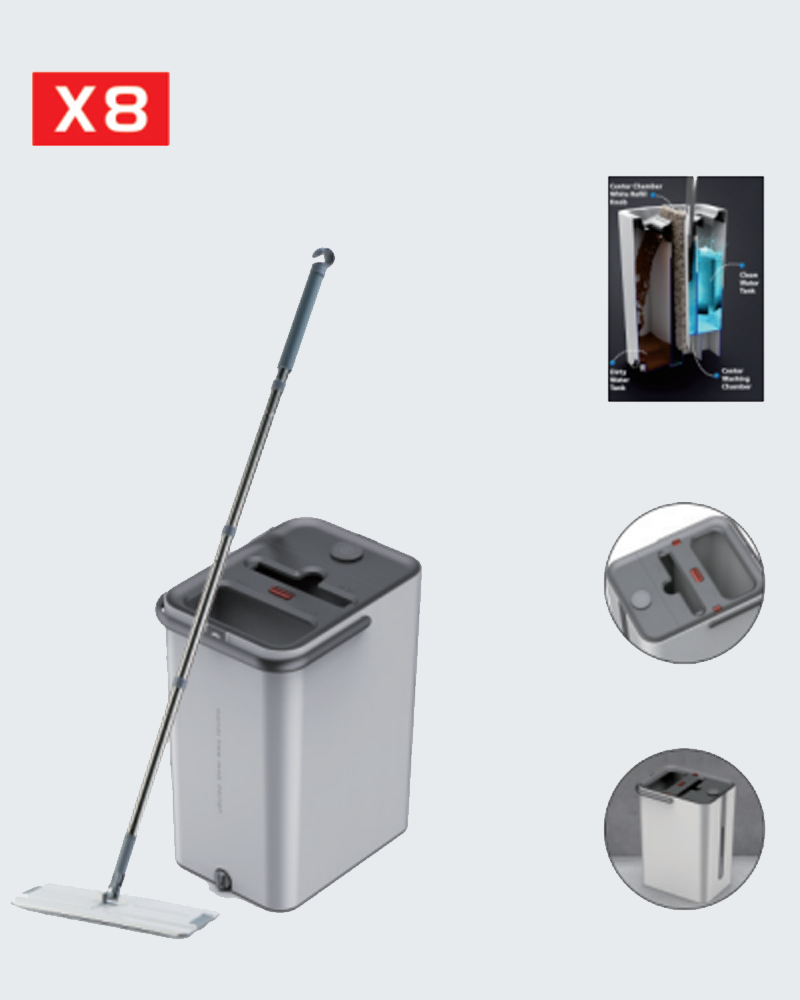
Many advanced hands-free flat mop bucket sets incorporate a dual-compartment design that physically separates clean water from the dirty water wrung out of the mop. This is a critical hygiene feature that standard single-bucket systems cannot replicate. In a single bucket, the first wring cycle contaminates the entire water supply, meaning every subsequent mop application re-deposits dirty water onto the floor. The floor may look clean but is actually being coated in a progressively more concentrated solution of the dirt removed in earlier passes.
The dual-compartment system keeps clean water in a dedicated chamber until it is dispensed onto the mop pad, while wrung-out dirty water drains into a separate chamber that never contacts the clean supply. This means the mop pad is always refreshed with uncontaminated water on every pass, delivering consistently clean results from the first stroke to the last — even across large floor areas.
Flat Mop Head Design: More Coverage, Better Contact
The flat mop head geometry is a fundamentally superior design for floor cleaning compared to the round or cylindrical profile of traditional string mops. The differences in cleaning effectiveness are direct and measurable.
Full-Surface Floor Contact
A flat mop pad lies parallel to the floor surface and maintains full contact across its entire width during each stroke. A typical flat mop head covers 40–60 cm of floor width per pass, and because the pad lies flat rather than bunching up like string mop fibers, every square centimeter of mop surface actively contacts and cleans the floor. String mops, by contrast, concentrate cleaning effort on the tips and outer edges of the fiber bundle, leaving much of the mop's material surface ineffective.
360-Degree Head Rotation for Tight Spaces
High-quality hands-free flat mop sets feature a mop head with 360-degree swivel rotation. This allows the user to pivot the mop head in any direction without changing their grip or body position — an advantage that makes cleaning under furniture, around toilet bases, into corner angles, and along baseboards significantly faster and more thorough than with a fixed-head mop. The user can angle the mop head parallel to a wall and slide it along the baseboard edge in a single smooth motion, something that requires awkward repositioning with a round string mop.
Microfiber Pad Performance Data
The microfiber material used in flat mop pads operates on a fundamentally different principle than cotton fibers. Microfiber strands — typically 0.1 to 0.5 denier in diameter, far finer than a human hair — create an enormous surface area within the pad. This structure generates electrostatic attraction that pulls fine dust, allergen particles, and bacteria into the fiber matrix rather than pushing them across the surface. Testing across multiple cleaning environments has consistently demonstrated:
- Microfiber mops remove up to 98–99% of bacteria from smooth floor surfaces with water alone, compared to 30–40% removal rates for cotton string mops using the same water.
- Microfiber pads retain soil within their fiber structure rather than releasing it back to the floor on subsequent passes, maintaining cleaning effectiveness throughout the session.
- A single microfiber pad can absorb six to eight times its own weight in liquid, reducing the frequency of bucket trips and increasing coverage per wring cycle.
Ergonomic Benefits: Protecting the User's Body
Cleaning is physically demanding work, and musculoskeletal injuries from repetitive bending, twisting, and wringing are a well-documented occupational health concern — particularly for professional cleaners and elderly users. Hands-free flat mop bucket sets address this directly through ergonomic design features that reduce the physical demand of every aspect of the cleaning process.
Eliminating Bending and Wringing Strain
The wringing mechanism in a hands-free system requires only a foot press or lever push — actions that use the body's larger muscle groups (legs, body weight) rather than the smaller muscles of the hands, wrists, and lower back that bear the stress in manual wringing. Traditional mop wringing exerts repeated torsional stress on the wrist, forearm, and lumbar region; over an extended cleaning session or a working lifetime, this contributes to conditions including carpal tunnel syndrome, tennis elbow, and chronic lower back pain.
The hands-free mechanism eliminates the need to bend down and grip the mop head entirely, reducing both the bending angle and the grip force required. For users with existing wrist or back conditions, this difference can make the difference between being able to clean independently or requiring assistance.
Ergonomic Handle Design
Premium hands-free flat mop sets use adjustable stainless steel handles (commonly SS201 grade for corrosion resistance) that extend to suit the user's height, allowing upright mopping without hunching or overreaching. The ability to set the handle length to the user's exact standing height means the spine remains naturally aligned throughout the cleaning session, dramatically reducing cumulative lumbar stress compared to the fixed-length handles on many conventional mops.
Stainless steel handles also offer a practical weight advantage over traditional wooden or painted steel handles — they are lighter per unit length, more rigid (reducing handle flex that wastes mopping effort), and resistant to moisture-related swelling or corrosion that degrades wooden handles over time.
Reduced Cleaning Session Time
Faster cleaning directly reduces physical fatigue. The flat mop head's wider coverage and the dual-compartment bucket's elimination of repeated water changes mean that the same floor area can be cleaned in 30–50% less time compared to a traditional string mop and single bucket setup. Less time mopping means less cumulative strain on muscles, joints, and the cardiovascular system — a benefit that compounds significantly over multiple cleaning sessions per week.
Versatility Across Floor Types and Cleaning Tasks
One of the most practically valuable advantages of a hands-free flat mop bucket set is its ability to perform effectively across a wide range of floor surfaces and cleaning scenarios — often replacing multiple specialized tools.
Compatible Floor Surfaces
The flat mop design with precise moisture control is suitable for surfaces that traditional string mops — which tend to leave floors too wet — can damage:
- Hardwood and engineered wood floors: Excess moisture causes warping, swelling, and finish deterioration in wood floors. The hands-free wringing mechanism allows precise moisture control, enabling damp mopping that cleans effectively without oversaturating the surface.
- Laminate flooring: Like hardwood, laminate is sensitive to water penetration at seams. A well-wrung flat mop pad delivers just enough moisture to clean without risking seam swelling.
- Ceramic and porcelain tile: The flat pad's full-surface contact cleans both the tile face and grout lines more effectively than the irregular profile of a string mop.
- Vinyl and luxury vinyl plank (LVP): Flat mopping provides even cleaning pressure without the abrasive bunching that can scratch softer vinyl surfaces.
- Marble and natural stone: Gentle microfiber contact cleans without scratching polished stone surfaces.
Wet Mopping and Dry Dusting in One Tool
Many hands-free flat mop sets include dry dusting capability — the same mop head used for wet mopping can be used dry to capture dust, pet hair, and fine debris through the microfiber's electrostatic attraction before wet mopping begins. This two-stage approach (dry dusting followed by damp mopping) is the professional cleaning standard because it prevents loose debris from being pushed into wet streaks by the mop. Having both functions in a single tool eliminates the need for a separate dust mop or floor sweeper, reducing equipment costs and storage space requirements.
Residential and Commercial Applications
The combination of professional-grade hygiene performance and ease of use makes hands-free flat mop bucket sets suitable across a wide spectrum of environments:
- Households with pets, children, or allergy sufferers — where floor hygiene directly affects indoor air quality and health outcomes
- Restaurants and commercial kitchens — where food hygiene regulations require consistent, demonstrably clean floor surfaces
- Healthcare facilities, clinics, and care homes — where infection control standards mandate the highest possible bacterial reduction on floor surfaces
- Hotels, offices, and retail spaces — where floors must be cleaned quickly without creating slip hazards from oversaturated mopping
- Schools and daycare centers — where children's proximity to floor surfaces makes high bacterial reduction especially important
Moisture Control: Protecting Floors and Reducing Slip Risk
The ability to precisely control how much moisture is applied to the floor is one of the most underappreciated advantages of the hands-free wring system. This control matters for two independent reasons: floor protection and user safety.
Protecting Sensitive Floor Finishes
Flooring manufacturers consistently specify "damp mopping" — not wet mopping — as the correct maintenance method for hardwood, laminate, and many vinyl products. Traditional string mops, even after manual wringing, typically leave floors significantly wetter than the damp standard because hand-wringing is inconsistent and leaves residual moisture in the fiber bundle. Excessive moisture left on hardwood floors can cause cupping, crowning, or finish clouding within months of installation if cleaning practices are incorrect.
The mechanical wringer in a hands-free flat mop system applies consistent, repeatable wringing force every time — the user can choose to wring more or less by adjusting the pedal pressure or number of press cycles, and the result is the same each time. This consistency allows users to reliably achieve the damp-but-not-wet moisture level that sensitive floors require.
Reducing Wet Floor Slip Hazards
Slip-and-fall accidents on wet floors are a significant safety concern in both commercial and domestic environments. The faster a mopped floor dries, the lower the window of slip risk. A well-wrung flat mop pad applied to a hard floor surface typically produces a floor that dries within 1–3 minutes, compared to 5–10 minutes or more for a heavily saturated string mop application. In commercial settings, this faster drying time directly reduces the duration for which warning signs must be displayed and the period during which a cleaned area must be kept out of service.
Durability and Material Quality: Built for Long-Term Use
The long-term cost of a cleaning system is determined not just by its purchase price but by its durability, replacement pad costs, and maintenance requirements. Hands-free flat mop bucket sets engineered with quality materials offer meaningful advantages in total cost of ownership.
Stainless Steel Handle Longevity
Handles manufactured from SS201 or higher grade stainless steel resist corrosion, bending, and surface degradation far longer than painted carbon steel or wooden alternatives. A quality stainless steel handle used daily in a domestic environment will typically outlast five to ten wooden or painted steel handles of equivalent price. The absence of paint means there is no surface to chip, peel, or harbor bacteria in surface cracks — an important consideration in hygiene-sensitive environments.
High-Grade Polypropylene Bucket Construction
The bucket body in a well-engineered hands-free mop set is typically manufactured from food-grade polypropylene (PP), which combines chemical resistance, impact durability, and lightweight handling. PP resists degradation from cleaning chemicals including bleach, ammonia, and acid-based cleaners that attack lower-grade plastics over time. A quality PP bucket maintains structural integrity and color without cracking, warping, or developing odors across years of daily use.
Washable and Reusable Microfiber Pads
Premium microfiber mop pads are designed to withstand repeated machine washing without losing their cleaning performance. High-quality pads maintain effective microfiber structure for 300–500 wash cycles — the equivalent of several years of daily use if washed after each session. This washability dramatically reduces the ongoing cost of the cleaning system compared to disposable pad alternatives and eliminates the waste generated by single-use cleaning products.
The dual-compartment separation system also extends pad life indirectly by ensuring pads are always rinsed with clean water rather than being recontaminated by dirty water during use. Pads that are not loaded with re-deposited soil between uses retain their fiber integrity longer and require less aggressive washing to restore cleanliness.
Cleaning Efficiency: Covering More Ground in Less Time
Efficiency — cleaning more floor area per unit of time and effort — is a measurable advantage that directly affects both the quality of results and the practicality of using the system regularly.
Wider Cleaning Path Per Stroke
A flat mop head typically spans 40–60 cm in width, compared to the effective cleaning width of a string mop which rarely exceeds 25–30 cm due to fiber bunching and irregular contact. This means each pass of the flat mop covers 50–100% more floor area than a traditional mop stroke at the same walking pace. Over the course of cleaning a 50 square meter apartment, this translates to several hundred fewer strokes — a significant reduction in time and physical effort.
Fewer Bucket Trips Due to Dual Compartment Design
With a traditional single-bucket system, users must change the water whenever it becomes visibly dirty — typically every 15–20 square meters in a moderately soiled environment. With the dual-compartment system, clean water remains uncontaminated in its dedicated chamber throughout the session, eliminating the need for mid-session water changes in most residential cleaning scenarios. For a typical home cleaning session, this may eliminate two to four bucket emptying and refilling cycles, each of which requires carrying a heavy bucket to a sink, emptying it, refilling it, and carrying it back — a cumulative time and effort saving that is felt in practice.
Instant Wringing Without Interrupting Workflow
The foot pedal or lever wring mechanism operates without the user needing to set down the mop, bend over, or change their grip. The entire wring cycle takes 2–4 seconds — a fraction of the time required for manual wringing — and can be performed as a natural pause in the cleaning stroke without interrupting the rhythm of work. This seamless integration of wringing into the cleaning motion is a practical efficiency advantage that users notice immediately and consistently report as one of the most appreciated features of the hands-free system.
Hands-Free Flat Mop vs. Traditional Mop: Direct Comparison
The table below places the key advantages of the hands-free flat mop bucket set directly alongside the performance of traditional string mop and single-bucket systems across every important evaluation dimension:
| Evaluation Criteria | Hands-Free Flat Mop Set | Traditional String Mop |
|---|---|---|
| Bacteria removal rate | Up to 98–99% | 30–40% |
| Hand contact with mop head | None required | Required for every wring |
| Water contamination during use | None (separated compartments) | Progressive contamination |
| Effective cleaning width per stroke | 40–60 cm | 20–30 cm |
| Moisture control precision | Consistent and adjustable | Inconsistent, operator-dependent |
| Suitable for hardwood floors | Yes | Risk of over-wetting |
| Corner and edge cleaning | Excellent (360° rotation) | Poor (fixed profile) |
| Physical strain on user | Low (ergonomic handle, foot wring) | High (bending, hand wringing) |
| Dry dusting capability | Yes (same mop head) | No (separate tool needed) |
| Floor drying time after mopping | 1–3 minutes | 5–10 minutes |
| Mop pad washable and reusable | Yes (300–500 wash cycles) | Limited (degrades faster) |
Storage and Portability Advantages
Storage space is a practical constraint in most homes and many commercial cleaning closets. Hands-free flat mop bucket sets are designed with spatial efficiency in mind in ways that traditional mop systems are not.
Compact Footprint
The flat mop head stores flat against the mop handle or folds to a compact position, requiring far less clearance height and floor space than a traditional round mop head stored in a bucket. Many flat mop handle designs allow the mop to be hung on a wall hook by its handle loop, keeping it off the floor entirely and preventing the mold and bacteria growth that develops in the damp base of a string mop stored in a bucket. The rectangular bucket profile of most hands-free flat mop sets also stacks and stores more space-efficiently than a traditional round bucket.
Lightweight Construction for Easy Carrying
A typical hands-free flat mop bucket set weighs 2–4 kg empty — significantly lighter than a traditional metal wringer bucket, which can weigh 4–6 kg empty and far more when filled. The lightweight construction makes the system easier to carry between rooms, up and down stairs, and to and from storage. For elderly users, people with limited upper body strength, or professional cleaners who carry equipment between multiple floors, this weight difference is a meaningful practical benefit.
Environmental and Economic Benefits Over Time
Beyond performance and hygiene, hands-free flat mop bucket sets offer measurable environmental and financial advantages when evaluated over their full operational lifespan.
Reduced Water Consumption
Because the dual-compartment system keeps clean water uncontaminated throughout the session, users do not need to change the bucket water mid-clean in most circumstances. Traditional single-bucket users typically change water two to four times during the cleaning of an average home, using 6–12 liters of water per change. Eliminating these mid-session changes can reduce total water consumption per cleaning session by 30–50% — a modest but consistent saving that accumulates meaningfully over hundreds of cleaning sessions per year.
Lower Chemical Consumption
Microfiber's superior cleaning action means that hands-free flat mop systems typically require far less cleaning chemical — and often none at all — to achieve the same or better bacterial reduction compared to string mops used with chemical cleaners. Cleaning with water alone using a microfiber pad achieves the 98–99% bacterial reduction noted earlier, whereas achieving comparable results with a cotton string mop typically requires disinfectant chemical addition. For households or facilities cleaning regularly, the reduction in chemical purchasing represents a direct ongoing cost saving and a reduced environmental chemical load.
Long-Term Cost of Ownership
The initial cost of a quality hands-free flat mop bucket set is higher than a basic string mop and bucket combination. However, when total cost of ownership is calculated over a three-to-five-year period — accounting for mop head replacement frequency, water and chemical consumption, and the value of time saved in cleaning — the hands-free flat mop system consistently delivers lower total cost. A microfiber pad rated for 400 wash cycles, replaced annually, costs a fraction of the equivalent string mop heads required over the same period, and the time saved per cleaning session has real monetary value when calculated at even a modest hourly rate.
Key Advantages Summary: What You Are Actually Getting
The advantages of a hands-free flat mop bucket set span hygiene, ergonomics, efficiency, floor protection, versatility, durability, and economics. Here is a consolidated reference of the most important benefits:
- Up to 99% bacterial removal from floor surfaces — far exceeding what cotton string mops can achieve with or without chemical cleaners.
- Zero hand contact with the mop head during wringing — eliminating the cross-contamination cycle that limits the hygiene performance of traditional systems.
- Clean and dirty water permanently separated — ensuring every mop pass applies uncontaminated water to the floor from start to finish.
- 40–60 cm effective cleaning width per stroke — covering 50–100% more floor area per pass than a standard string mop.
- 360-degree head rotation — reaching corners, edges, and under furniture without awkward repositioning.
- Consistent moisture control — safe for hardwood, laminate, and other moisture-sensitive floor types that traditional mops risk damaging.
- Reduced physical strain — ergonomic handle and foot-operated wringer protect the back, wrists, and joints during extended cleaning sessions.
- Dry dusting and wet mopping in one tool — replacing multiple cleaning implements with a single versatile system.
- 300–500 wash cycles per pad — making the system cost-effective, low-waste, and environmentally responsible over its full service life.
- Faster floor drying — reducing slip hazard windows from 5–10 minutes to 1–3 minutes per cleaned area.
For anyone who cleans floors regularly — whether in a family home, a professional cleaning role, or a commercial facility — a hands-free flat mop bucket set is not merely a convenience upgrade but a meaningful improvement in cleaning outcomes, health protection, and physical wellbeing. The combination of superior hygiene technology, ergonomic design, and durable materials makes it the most complete and effective floor cleaning system available for everyday use.